Fabien Cousteau's Groundbreaking Mission 31: A Deep Dive into Ocean Research and Legacy
Ocean explorer Fabien Cousteau continued his family's legacy with Mission 31, a record-breaking 31-day underwater expedition at the Aquarius lab, gathering critical data on marine life.


Tyler Henry Unearths Chrissy Metz's Emmys Night Mystery | Hollywood Medium | E!

Tyler Henry Connects Chrissy Metz to Murdered Friend & Predicts Stage Debut | Hollywood Medium |E!
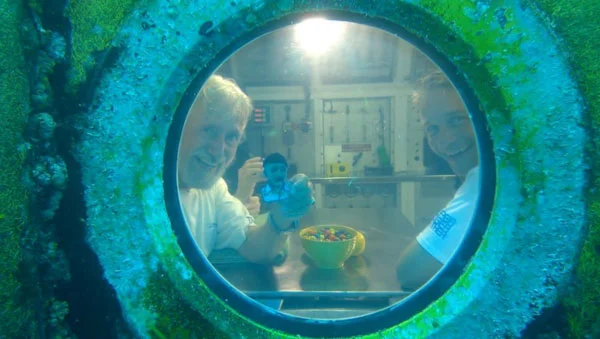
Fabien Cousteau, grandson of the legendary Jacques Cousteau, recently concluded a groundbreaking 31-day underwater expedition in the Atlantic Ocean, setting a new record for continuous habitation in the National Oceanic and Atmospheric Administration’s Aquarius underwater laboratory. Dubbed "Mission 31," this ambitious project saw Cousteau and a rotating team of scientists, filmmakers, and activists residing 63 feet below the surface, dedicated to understanding the profound impacts of pollution and climate change on marine ecosystems. The mission not only gathered an unprecedented volume of scientific data but also served as a powerful continuation of a family legacy deeply intertwined with ocean exploration.
A Modern Astronaut in the Ocean Depths
For those witnessing Fabien Cousteau during his remarkable stay, he presented a figure reminiscent of an astronaut navigating the vastness of space, yet his domain was 63 feet beneath the ocean’s surface. Stationed at Aquarius, the world's sole operational habitable underwater science lab, Cousteau and his team embarked on a record-breaking 31-day mission. During this extended period, they conducted critical research, including monitoring the vital signs of coral exposed to various pollutants like fertilizer runoff. Cousteau expressed his concern, noting that what they discovered regarding the degradation of reefs near human populations was "pretty surprising." This deep-sea commitment underscores a pivotal effort to confront the environmental challenges facing our oceans Time Magazine.
Mission 31: A Legacy Continued
From June 1 to July 2, Mission 31 saw more than 30 experts, including oceanographers, filmmakers, and activists from institutions like MIT and Florida International University, living and working aboard Aquarius. This extensive team conducted vital research and documented their findings for a documentary within a marine protected area positioned nine nautical miles off the Florida Keys. The mission holds profound significance for Cousteau, driven by his deep concern for the state of the oceans and his desire to expand our understanding of how pollution and climate change are altering marine environments. Beyond its contemporary scientific goals, Mission 31 directly extends his family's pioneering work. Fifty years prior, his grandfather, the iconic ocean explorer Jacques Cousteau, conducted a 30-day underwater mission, where six aquanauts lived below the Red Sea’s surface to study the practicality of working on the seafloor. Fabien's Mission 31 is a direct response to his grandfather's lifelong call for global passion and concern for the oceans.
The Challenges and Wonders of Underwater Living
Accessing the 400-square-foot Aquarius lab presents a formidable challenge, even for seasoned divers. The journey begins with a boat ride from Islamorada Key, leading to a yellow platform approximately 30 feet wide that serves as a crucial link to the mainland, housing generators and essential equipment. Aquarius, first funded by the National Oceanic and Atmospheric Administration in the mid-1980s, offers basic necessities with six bunks, a kitchen, and a toilet. Modern advancements, including Wi-Fi, enable a continuous 24/7 live stream monitored by a land-based team, all at an operational cost of approximately $15,000 per day. The descent to the lab itself is an arduous undertaking; strong currents necessitate pulling oneself down a line to the habitat. Upon reaching the depth of 63 feet, the scene transforms into an astonishing underwater scientific outpost, characterized by equipment-dotted seafloor, air bottles, and support systems, with Aquarius itself adorned with coral and sponges. An adjacent structure, known as the Gazebo, stands as an emergency refuge, resembling a lunar lander Time Magazine.
Technological Leaps and Scientific Discoveries
Observing Cousteau's work with coral brings into sharp focus the profound parallels between Mission 31 and Jacques Cousteau’s pioneering expedition. It also highlights a critical realization: despite fifty years of exploration, a mere 5% of the world’s oceans have been explored. This reality underscores the vital importance of technological advancements since Jacques’s era. Scientists are now better equipped than ever to study the effects of pollution and climate change on marine life, benefiting from improved data logging via computers, hair-thin sensors, and high-speed cameras that capture phenomena beyond human visual capabilities. Advanced underwater breathing equipment has also revolutionized aquatic science and recreation globally.
Mission 31, for instance, allocated significant photographic resources to studying predator behavior. High-speed cameras captured a mantis shrimp consuming its prey, a seemingly simple act that nevertheless requires isolating movements occurring within fractions of a second. Cousteau explained to TIME, "You have to sit there for hours to get a few milliseconds of natural behavior."
Mission Accomplished, A Future Uncharted
On July 2, Mission 31 concluded, marking an "emotional" departure for Cousteau from the aquatic world he had inhabited. He described growing accustomed to the constant presence of marine life—eels, sharks, and barracudas—observing their human visitors in their natural environment. While the length of the mission was its most dramatic aspect, Cousteau and his team are optimistic that its impact will be long-lasting. The scientists amassed the equivalent of two years' worth of research, a feat made possible by eliminating travel time between land and the seafloor and overcoming the limitations of depleting air tanks Time Magazine.
Their extensive trove includes 12 terabytes of data, equivalent to some 750 fully-loaded iPads, which Cousteau estimates could generate ten new research papers. The investigations spanned various critical topics, including predator-prey dynamics, the effects of specific nutrients on coral, and the potential presence of hydrocarbons from oil spills. If these findings materialize as hoped, they represent a significant contribution to ocean research. While Aquarius will continue to host researchers for shorter durations, with NASA scheduled to study human interaction in isolated environments, Cousteau's gaze is already fixed on the horizon, hoping for the launch of "Mission 32" in the near future.
Related Articles

Kristen Stewart Considers Leaving America, Citing Creative Restrictions
Actress Kristen Stewart reportedly contemplates departing the United States due to perceived limitations on her ability to "work freely," sparking discussion about creative freedom in Hollywood.