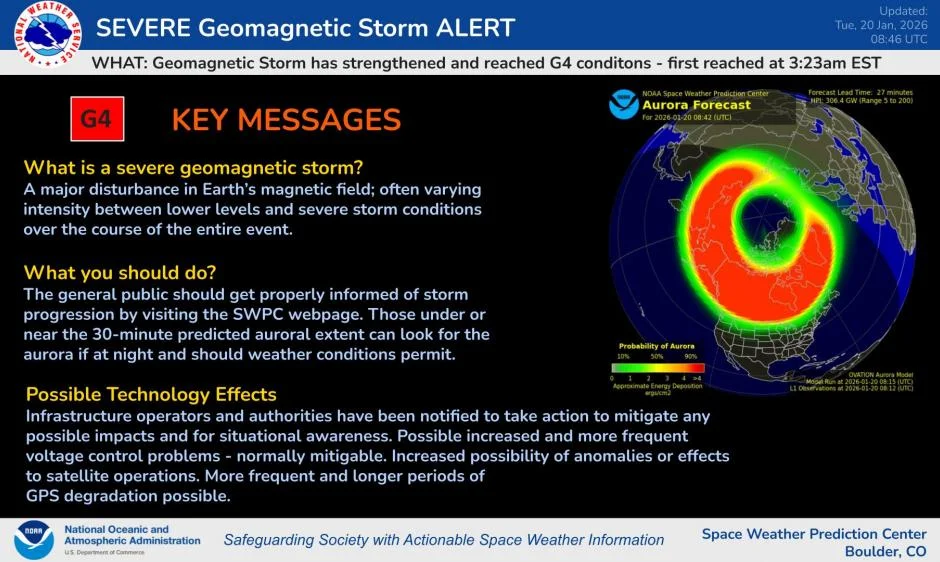
Major Geomagnetic Storm: Space Weather Prediction Center Issues Alert
The Space Weather Prediction Center has issued a G4 severe geomagnetic storm watch, leading to aurora sightings and power grid concerns.

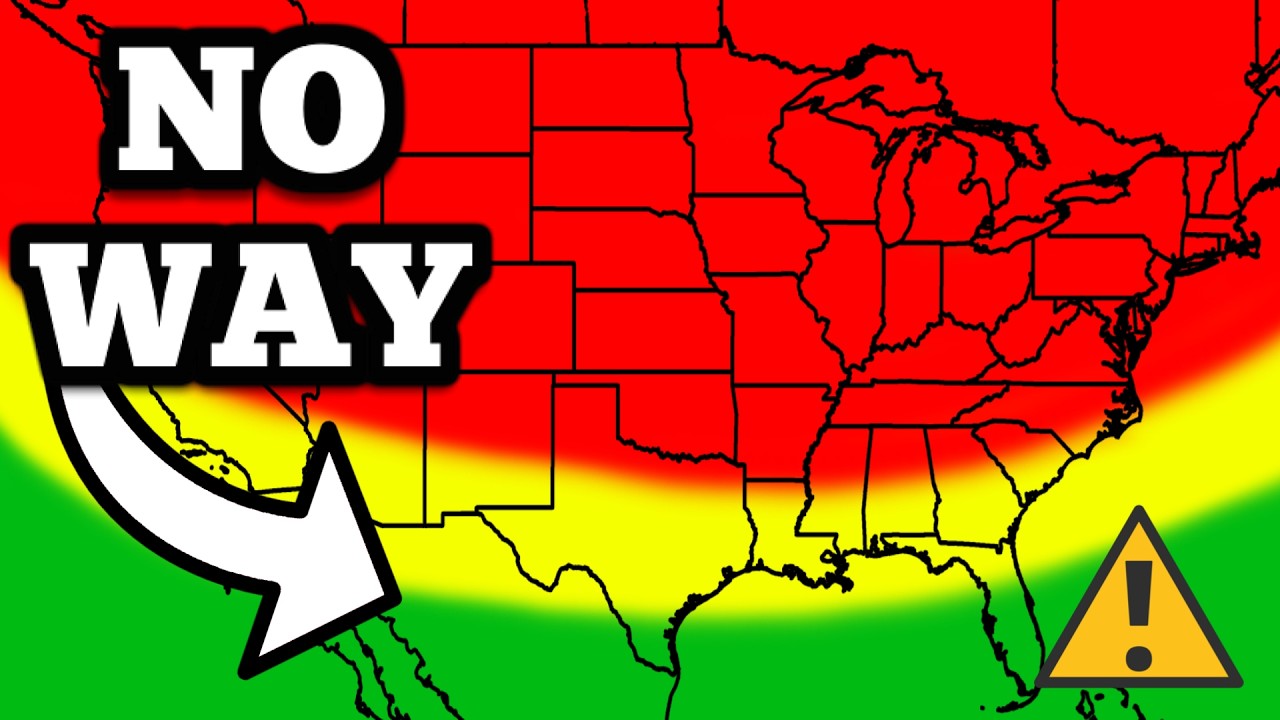
Major Geomagnetic Storm Will Impact Earth TONIGHT...
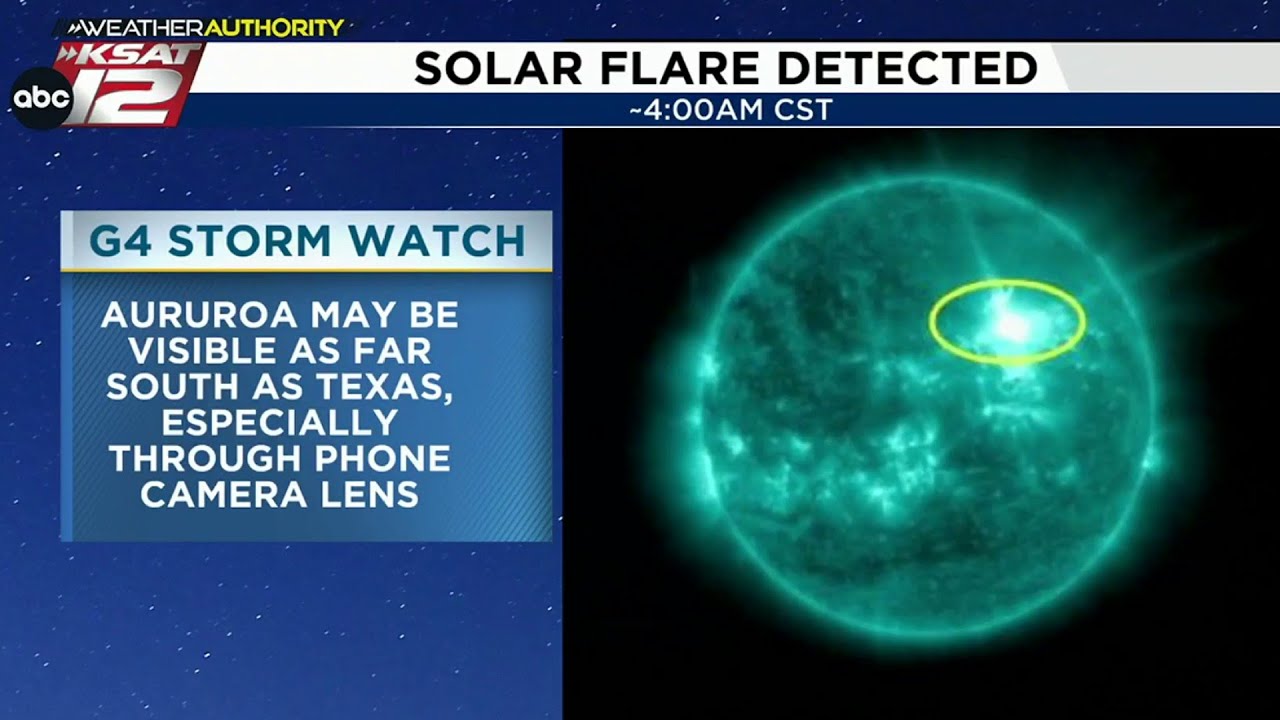
GEOMAGNETIC STORM ALERT: What does it mean for Texas, San Antonio?

A major G4 to G5 geomagnetic storm is expected to hit Earth today.
The National Oceanic and Atmospheric Administration's (NOAA) Space Weather Prediction Center (SWPC) has issued a G4 (Severe) geomagnetic storm watch for January 2026, triggering widespread alerts about potential disruptions to infrastructure and offering a rare opportunity for aurora sightings across unusual latitudes.
Severe Geomagnetic Storm Impacts Earth
The severe G4 geomagnetic storm, observed to have reached Earth on Monday, January 19, 2026, has already begun to manifest its effects. The SWPC, a division of the National Weather Service, reported powerful solar activity that resulted in an intense solar radiation storm, designated as a level four out of five on the severity scale. This event has been characterized as "the largest solar radiation storm in over 20 years," a significant occurrence last seen at severe levels in October 2003, which led to power outages in Sweden and damage to power transformers in South Africa. The current storm has already led to colorful auroral displays and reported GPS issues for aircraft. CNN’s Ashley Strickland reported on the event, highlighting the storm's intensity and its immediate consequences.
Auroras Visible Far Afield
One of the most captivating aspects of a strong geomagnetic storm is the enhanced visibility of the aurora borealis, or Northern Lights. This current event is no exception, with auroras reported to be visible far south of their typical range. Forecasts indicated that these dazzling light shows might be seen as far south as Alabama and even in parts of Mexico. DTN.COM and MachineryLink Blog both highlighted the potential for southern aurora sightings. These vibrant displays occur when high-energy plasma and magnetic fields ejected from the sun interact with Earth’s magnetic field, transferring energy into our planet's atmosphere. This interaction excites gases, causing them to emit light. Daisy Dobrijevic of Space.com provided stunning photographic evidence and reports of these worldwide aurora displays.
Potential Risks to Power Grids and Communications
While the auroras offer a spectacular natural phenomenon, the severe G4 geomagnetic storm carries significant risks, particularly for modern infrastructure. The SWPC warned that such space weather can overwhelm electrical systems, posing a threat to power grids, especially in northern U.S. states. Newsweek reported that this severe geomagnetic storm could disrupt electric grids across 11 northern U.S. states and potentially lead to large-scale power and communications outages. The increasing demand on electrical grids and the stress on infrastructure from climate and technological expansion exacerbate these vulnerabilities. Early reports from NOAA SWPC included R1 (Minor) Radio Blackout Impacts on Sunday night, resulting in "weak or minor degradation of HF radio communication on the sunlit side, [and] occasional loss of radio contact." A previous G4 warning in November also highlighted the potential for significant power grid disruptions, particularly for states north of the 45th parallel.
Understanding Geomagnetic Storms
A geomagnetic storm is a major disturbance of Earth's magnetosphere that occurs when there is a very efficient exchange of energy from the solar wind into the space environment surrounding Earth. These storms are caused by high-speed streams of solar wind and coronal mass ejections (CMEs). CMEs are large expulsions of plasma and magnetic field from the Sun's corona. When a CME directed towards Earth arrives, its magnetic field interacts strongly with Earth's magnetic field, transferring energy into the magnetosphere. This influx of energy can deform the magnetosphere's shape, accelerate particles, and induce electric currents in the ionosphere and ground, leading to the various effects observed during a geomagnetic storm.
Safety and Preparedness Measures
In light of the G4 severe geomagnetic storm watch, authorities are urging individuals and critical infrastructure operators to exercise caution and review emergency preparedness plans. For the general public, this might include ensuring backup power options, especially for those reliant on medical devices, and having alternative communication methods in case of widespread outages. Astronauts in low-Earth orbit, such as those on the International Space Station, face increased radiation exposure risks, and flight paths for aircraft traveling polar routes are often adjusted to mitigate risks from intense solar radiation. While the dazzling auroras provide a mesmerizing display, the underlying potential for infrastructure impact underscores the importance of ongoing space weather monitoring and preparedness efforts.
Related Articles
Montana Day in Focus: Community Rallies for Froid Business Owner, Wheel of Fortune Appearance
Explore the top trending news stories across Montana for January 29, 2026, including a community rallying for a Froid business owner, a ground-breaking in Great Falls, and a Montana man set for national television.