Nationwide Winter Storm Snarls US Flights, India Battles Localized Challenges
A massive winter storm grounds over 8,000 flights in the US, while India reports railway damage, water contamination, and political disputes.

A widespread and severe winter storm is currently impacting large swathes of the United States, leading to the cancellation of over 8,000 flights. Concurrently, various regions across India are grappling with their own set of challenges, ranging from damaged infrastructure and public health concerns to political tensions and wildlife alerts. This snapshot of global and national events highlights a day marked by significant disruptions and ongoing developments.
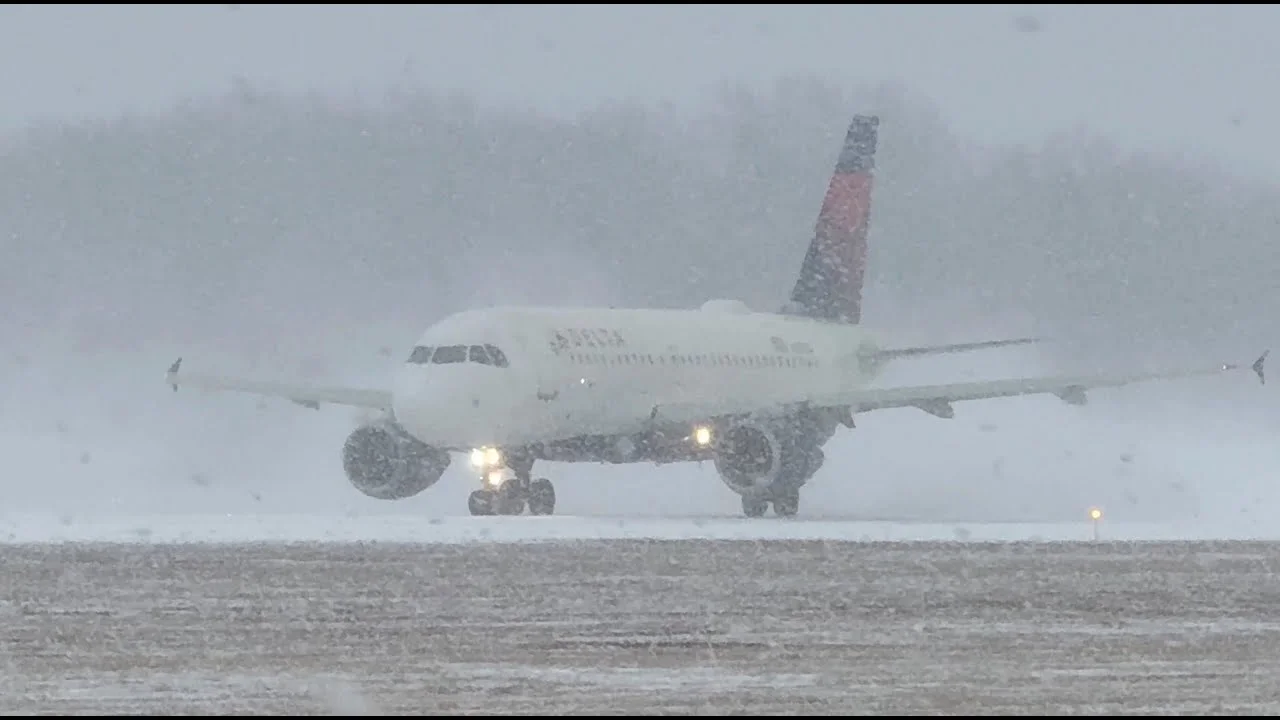
US Brace for Catastrophic Winter Storm, Thousands of Flights Cancelled
The United States is facing a major winter storm expected to wreak havoc across much of the country, prompting the cancellation of over 8,000 flights scheduled for the upcoming weekend. The National Weather Service has issued warnings for widespread heavy snow and a "catastrophic" ice band extending from east Texas to North Carolina. Approximately 140 million people are under a winter storm warning, with forecasters cautioning that potential damage, particularly from ice, could be comparable to that inflicted by a hurricane. Governors in more than a dozen states have already declared emergencies or urged residents to remain indoors.
The storm's initial effects were felt on Friday night (January 23), with freezing rain and sleet hitting parts of Texas, and snow and sleet falling in Oklahoma. Following its trajectory through the South, the storm is anticipated to move into the Northeast, with predictions of up to a foot (30 centimeters) of snow from Washington through New York and Boston, according to The Federal.
India Faces Diverse Challenges: From Damaged Rail Tracks to Contaminated Water
While the US battles extreme weather, India is confronting a range of localized issues. In an unsettling development, a portion of a railway track used for freight trains near Sirhind in Punjab's Fatehgarh Sahib district was discovered damaged on Friday night (January 23). Police are actively investigating whether an explosion caused the damage. A Government Railway Police official confirmed that the track, located near Khanpur village and used exclusively for goods trains, was found wrecked. A case under Section 150 of the Railways Act, pertaining to maliciously wrecking or attempting to wreck a train, has been registered.
Further south, the administration in Indore, Madhya Pradesh, has initiated extensive measures following suspected cases of water contamination. Twelve survey teams have been deployed and two temporary hospitals established in Mhow to treat residents falling ill. This proactive response comes after at least 12 suspected cases of stomach infection were detected in the Patti Bazaar area of Mhow on Friday (January 23). Locals claim the number of affected individuals is closer to 24. These recent incidents follow the deaths of seven people linked to water contamination in the Bhagirathpura area of Indore city last month, underscoring a critical public health concern.
Srinagar Airport Resumes Operations; IndiGo Adjusts Flight Schedule
In Kashmir, flight operations at Srinagar airport resumed on Saturday (January 24) after a day-long suspension due to heavy snowfall. Officials confirmed that the Airports Authority of India, in collaboration with BRO, successfully cleared the apron and taxiways, making the runway functional following an improvement in weather conditions. A major snowfall on Friday had forced the cancellation of flights as snow accumulated on the runway. While flight operations are expected to run normally, an early morning IndiGo flight was cancelled due to unfavorable weather in Srinagar, and others were impacted by NOTAM (Notice to Airmen) at Delhi, as reported by The Federal.
Meanwhile, IndiGo, India's largest airline, has vacated over 700 slots at various domestic airports. This action follows the aviation watchdog DGCA curtailing the airline's winter flight schedule by 10 percent due to significant operational disruptions in early December. The vacated slots, totaling 717, are spread across the January-March period, with a substantial number (364) from six key metro airports: Delhi, Mumbai, Chennai, Kolkata, Bengaluru, and Hyderabad. Most of these vacated slots are from Hyderabad and Bengaluru. The Ministry of Civil Aviation has since invited other airlines to submit requests for operating domestic flights on these newly available slots.
Political Tensions in Tamil Nadu; Leopard Captured in Palakkad
Political discourse in Tamil Nadu saw Chief Minister MK Stalin strongly criticize Governor RN Ravi for not reading the speech at the commencement of the Assembly session. Stalin asserted that Governor Ravi "insulted" the gubernatorial position by his actions, claiming that previous governors in Tamil Nadu had not engaged in such conduct. The Chief Minister pointed out that the National Anthem traditionally plays at the conclusion of the Governor's speech, with Tamil Thai Vazhthu (Mother Tamil invocation) at the commencement. Stalin stated, "We are not inferior to anyone in patriotism, and no one needs to teach us," while also contending that crime rates under the current DMK regime are lower compared to the previous AIADMK rule.
In environmental news, a leopard that had strayed into a human settlement in Palakkad, Kerala, and attacked domestic animals, was successfully captured in a cage trap on Saturday (January 24). Forest officials confirmed the leopard's presence after it attacked a calf in the Thachampara area. Residents' concerns about further attacks prompted the Forest Department to monitor the animal's movement and set up a trap. The captured leopard will be shifted to a nearby forest station for health assessment before a decision is made on its release into a forest area.
Delhi Experiences Sharp Temperature Drop, Improved Air Quality After Rain
Delhi witnessed a significant drop in temperatures and a slight improvement in air quality on Saturday (January 24) following a spell of rain a day prior. The India Meteorological Department (IMD) reported that the Safdarjung station recorded a minimum temperature of 7.6 degrees Celsius, a sharp decrease from Friday’s 13.7 degrees Celsius, which was the highest in four years. Other major stations like Palam and Lodhi Road registered 6.8 degrees Celsius, while The Ridge recorded 6.6 degrees and Ayanagar the coldest at 6 degrees Celsius.
The city's air quality saw a minor improvement, with the average Air Quality Index (AQI) settling at 256, categorizing it as 'poor,' compared to 293 on Friday. The Central Pollution Control Board's (CPCB) Sameer app provided this data. The Air Quality Early Warning System forecasts that Delhi's air quality will remain in the 'poor' category for the next two days, with a likelihood of 'poor' to 'very poor' conditions in the subsequent six days. The IMD also predicts generally cloudy skies and shallow to moderate fog during morning hours, coupled with strong surface winds. These updates underscore the ongoing environmental fluctuations in the capital, according to The Federal.
Related Articles

Joby Aviation Stock Tumbles 13% on $1 Billion Capital Raise Plan
Joby Aviation shares dropped significantly after announcing plans to raise $1 billion through stock and convertible note sales, sparking dilution fears among investors.