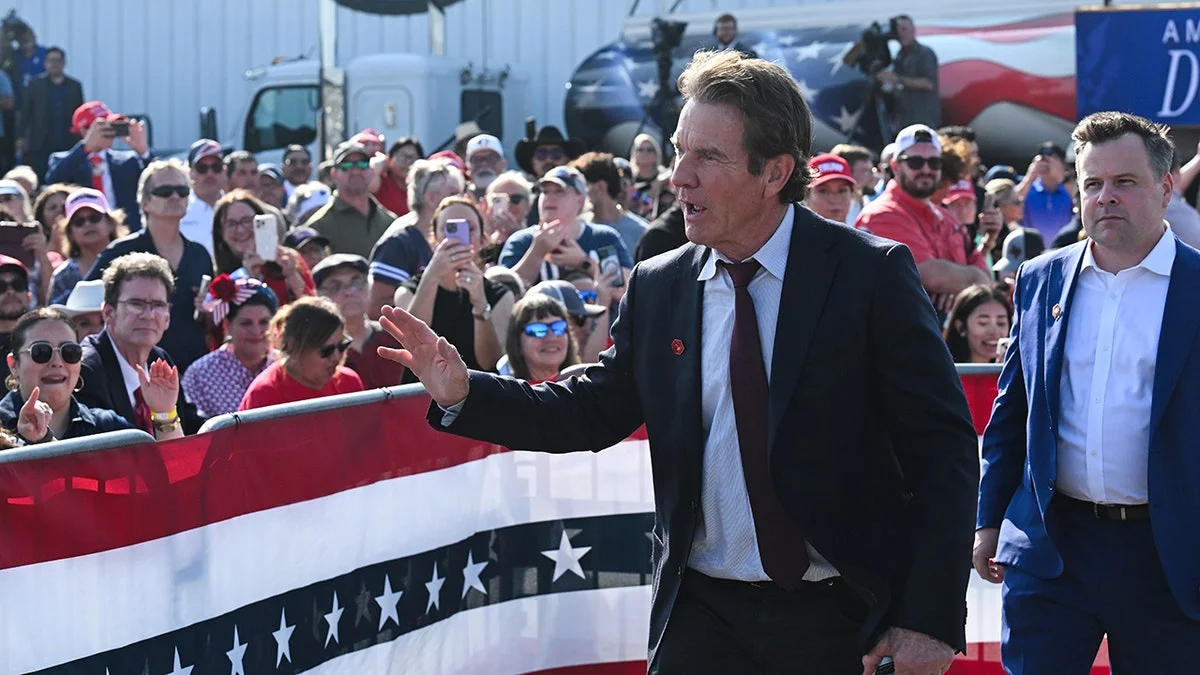
In a candid interview that has sent ripples through the entertainment industry, veteran actor Dennis Quaid has openly challenged what he perceives as a significant "double standard" within Hollywood concerning political affiliations, specifically support for former President Donald Trump. Quaid's remarks, shared with Fox News Digital and reported by Page Six, come as he promotes his new action/sci-fi film, “War Machine,” co-starring Alan Ritchson. The actor’s willingness to express his views on a topic often considered taboo in Tinseltown underscores a growing tension between celebrity political expression and industry expectations, particularly for those who deviate from the perceived norm.
Background and Context: Hollywood's Political Landscape
Hollywood's public political leanings have long been a subject of discussion, with the industry generally perceived as a bastion of liberal thought. For decades, celebrities have leveraged their platforms to advocate for various causes and candidates, often aligning with progressive viewpoints. This environment has historically created a challenge for artists whose political ideologies diverge from the mainstream consensus. While many actors, directors, and musicians freely voice their support for Democratic candidates and policies, those who publicly endorse Republican figures, especially as polarizing as Donald Trump, frequently face scrutiny, backlash, or even professional repercussions. This phenomenon, often dubbed "cancel culture" by its critics, reflects a broader societal tension where political alignment can intersect with professional identity. Dennis Quaid's recent comments echo sentiments shared by a small but vocal minority of Hollywood figures who feel that open support for conservative politicians, particularly Trump, invites a level of condemnation not meted out to those on the other side of the political spectrum. His "double standard" accusation is not new but gains renewed prominence when articulated by a well-established and respected actor.
Key Developments: Quaid's Assertions and Presidential Encounters
Dennis Quaid minced no words in his assessment of Hollywood's political climate, telling Fox News Digital, "There’s either ‘F Trump’ from the other side or ‘I love Trump’ from a few of us who speak about it." As reported by Page Six, Quaid elaborated on the existence of a pervasive "double standard on everything," likening certain contemporary ideological stances to scenarios as improbable as a man competing in women’s sports or voting twice. His remarks explicitly link the entertainment industry’s political intolerance to broader cultural debates. Further adding to the narrative, Quaid recounted recent conversations with former President Trump regarding his new movie, “War Machine,” available on Netflix. Trump, according to Quaid, expressed interest in the film, an action/sci-fi narrative about "aliens versus humans," and even jokingly suggested he might "release the file," hinting at potential prequel material. These interactions evidently left a significant impression on Quaid, who described flying with Trump on Air Force One as "fantasy camp" and "pretty amazing." He vividly detailed the experience, noting the familiar "war room" setting with military personnel and even the "nuclear football" within the president's plane. Quaid also offered an intimate glimpse into a high-stakes moment, recalling being with the president before coordinated strikes against Iran. He described Trump as exhibiting a remarkable "poker face" while grappling with the difficult decision, conveying the heavy burden of sending service members into harm's way, suggesting a deeper, more empathetic side to the former commander-in-chief than often portrayed. Quaid humorously observed that the venerable Air Force One felt like a relic from the 1990s, indicating its age despite meticulous maintenance, reinforcing a sentiment often echoed in discussions about presidential assets. While CNN's "Hollywood Minute" and IMDb's news feed provide broader entertainment updates, Quaid's specific political commentary and detailed personal anecdotes with Trump underscore a unique celebrity perspective rarely openly discussed in mainstream entertainment circles.
Analysis: What This Means for Entertainment and Public Discourse
Quaid's outspokenness regarding Hollywood's political climate and his positive portrayal of interactions with Donald Trump carries significant weight, signaling a potential shift or at least a renewed challenge to the industry's prevailing narratives. For actors and other creative professionals who hold conservative views, Quaid’s remarks offer a form of validation, highlighting the perceived intellectual and social ostracization they sometimes face. It also forces a critical examination of the concept of "tolerance" within liberal-leaning industries, questioning whether it extends to those with opposing political beliefs. This situation could further widen the ideological chasm within Hollywood, potentially creating more distinct factions or emboldening others to voice dissenting opinions. From a broader societal perspective, Quaid's comments contribute to the ongoing national conversation about polarization and the difficulty of finding common ground across political divides. When a public figure like Quaid, known for a diverse filmography and broad appeal, speaks so directly about a "double standard," it resonates with those who feel similarly marginalized in various professional and social spheres. It challenges the notion that entertainment figures must conform to a specific political ideology to maintain their careers and standing, potentially laying the groundwork for a more diverse range of public political expression from celebrities in the future, even if such expressions remain controversial.
Additional Details: "War Machine" and Quaid's Evolving Career
Beyond the political commentary, Dennis Quaid extensively discussed his new film, "War Machine." He expressed being drawn to the project because it evoked the feeling of classic 1980s action movies like "Rambo," suggesting a return to a specific genre that he believes audiences are craving. Quaid asserted that the film "really does deliver," speaking to its potential appeal to fans of old-school action. A significant draw for him was his co-star, Alan Ritchson, whom Quaid praised as a "great star" and lauded for his physical prowess and believable action performances. He also commended director Patrick Hughes, describing him as "a kid in a candy store" during production, which made for a fun experience. Quaid, who played a general in the film, humorously noted his gratitude for not having to get his uniform dirty, a stark contrast to Ritchson's more physically demanding role. This alludes to Quaid's own extensive career experiences, where he recalled past instances of being "up to my neck in mud in Slovakia" while acting to "three tennis balls on a stick." This veteran perspective underscores his respect for the military, despite never having served himself, highlighting the importance of "getting it right" when depicting service members on screen. He emphasized his desire to create a movie that those in the military would genuinely want to watch. This appreciation for the military ties back to his broader patriotic sentiments, where he noted how traveling has deepened his understanding and appreciation for the uniqueness and "wonder of the world" that is the United States. Quaid also reflected on his career trajectory, expressing a greater love for acting now than in his younger years. He attributes this renewed passion to a shift in motivation—no longer driven by a need for awards or external validation, but purely by the "enjoyment" and "fire in my belly" for the craft. This perspective suggests a seasoned artist comfortable in his own skin, taking on roles for personal satisfaction rather than industry acclaim, as noted by Page Six. His recent comments about "The Parent Trap" revitalizing his career further illustrate this ongoing evolution.
Looking Ahead: The Cultural Impact of Celebrity Political Discourse
Dennis Quaid's recent interview provides a critical lens into the evolving landscape of celebrity political engagement and the inherent tensions within Hollywood. As "War Machine" gains traction on Netflix, Quaid's commentary on the industry's "double standard" is likely to continue sparking conversation. His willingness to speak candidly about his interactions with a divisive political figure like Donald Trump, and his subsequent critique of Hollywood's responses to such allegiances, could inspire other actors and industry professionals to be more open about their own political beliefs, regardless of where they fall on the spectrum. This trend could lead to a more diverse and arguably more honest public discourse from the entertainment sector, challenging the perceived monolithic political identity of Hollywood. However, it could also exacerbate existing divisions and lead to further debates about the role of celebrities in political commentary. The reception of Quaid's film, "War Machine," may also be subtly influenced by his political statements, demonstrating the enduring interconnectedness of celebrity personas, artistic endeavors, and public opinion in today's hyper-polarized environment.