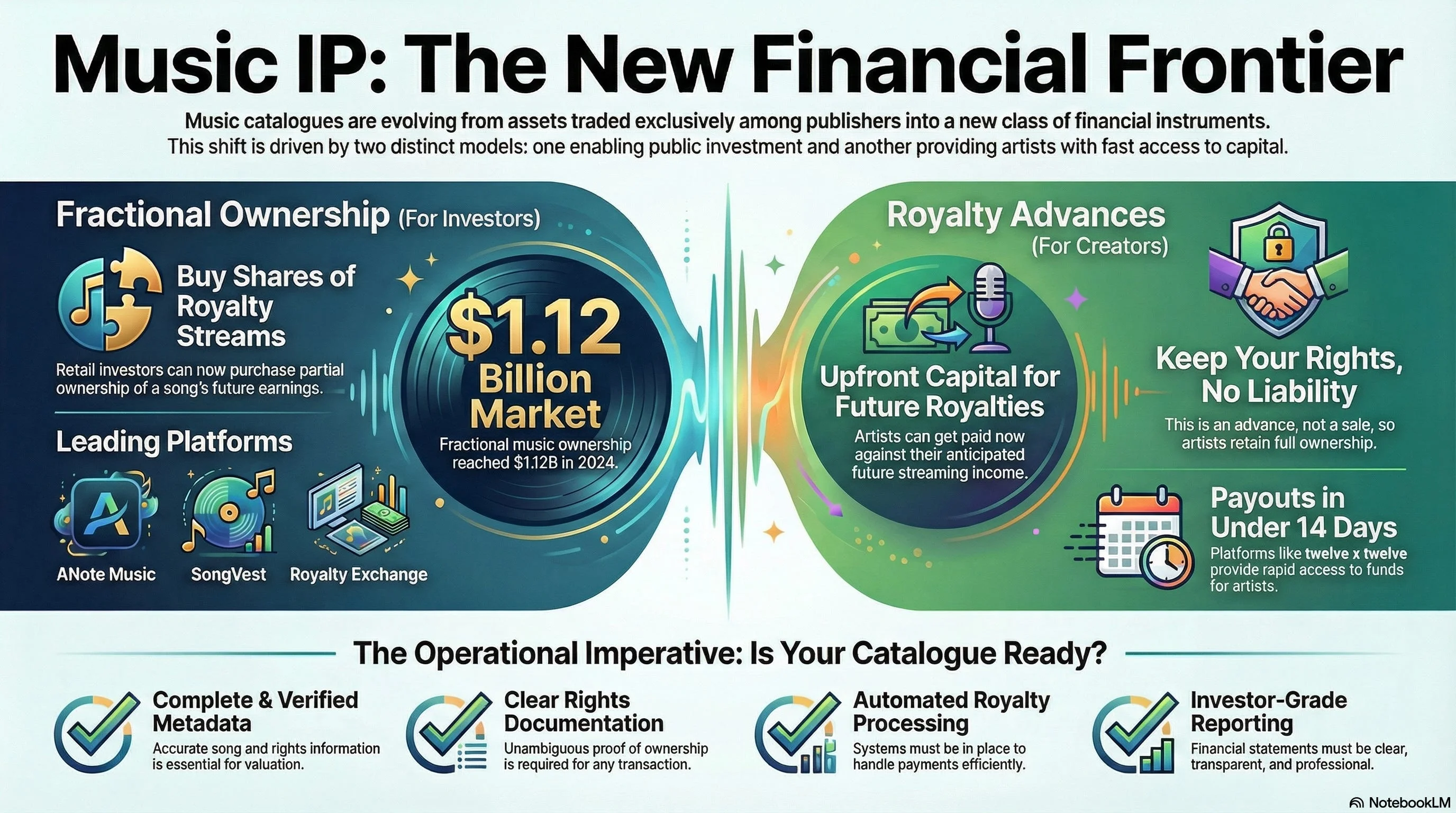
Prediction Markets: The New Frontier for Music Industry Investment and Fan Engagement
Prediction markets like Kalshi are transforming how fans engage with music and how the industry anticipates trends, creating new avenues for investment and challenging traditional models.

The landscape of the music industry is undergoing a significant transformation, driven not by traditional record labels or streaming giants, but by the innovative power of prediction markets. Platforms like Kalshi are empowering music fans to put their acumen to the test, betting real money on everything from album sales to future chart-toppers. What began as a niche interest for chart obsessives is quickly evolving into a formidable force, creating a new breed of informed investors and forcing the industry to take notice. This burgeoning trend highlights a shift where deep fan knowledge, once relegated to online forums, now carries tangible financial weight, as exemplified by ordinary individuals turning their passion into substantial profit, profoundly altering their lives.
The Rise of Prediction Markets in Popular Culture
The concept of prediction markets, where users wager real money on the outcome of future events, is not entirely new, but its application and scale have dramatically expanded in recent years. Kalshi, launched in 2021, stands as a prime example of this growth. Positioned not as gambling but as a form of investment akin to futures trading, regulated federally through the Commodities and Futures Trading Commission, these platforms offer hundreds of thousands of markets across diverse categories – from politics and economics to sports and popular culture. The allure is evident in Kalshi’s remarkable traction; it has consistently been one of the most downloaded apps on Apple and recently recorded $10 billion in trading volume in a single month, with $1 billion attributed to the Super Bowl alone. While sports dominate a significant portion of this activity, entertainment, including music, is rapidly capturing a larger share. For instance, the Super Bowl halftime show alone saw over $150 million traded on predictions related to songs and performers, underscoring the immense potential and growing interest in music-centric markets, as reported by Rolling Stone.
From Fan Obsession to Financial Foresight
The story of Brandon Fean, a 25-year-old middle school teacher, epitomizes the transformative potential of these platforms for dedicated music fans. Fean’s journey began innocently enough in January 2024, when his quest to uncover the title of Ariana Grande’s unreleased album led him to discover a crucial piece of “alpha” – a unique insight into upcoming album sales. By examining the source code of Grande's website, he found data on vinyl inventory, a clear indicator of physical sales that most others overlooked. This granular understanding of the music business, combined with his lifelong obsession with Billboard charts, laid the groundwork for his eventual success on Kalshi. Initially losing money on political predictions, Fean almost quit, but a friend encouraged him to apply his deep music knowledge to Kalshi's music markets. His turning point came when he correctly predicted Travis Scott would outperform Lady Gaga and Bruno Mars for the Number One spot on the Hot 100, leveraging his understanding of Scott’s “pure sales giant” status and access to early physical sales data. A $80 investment based on this insider knowledge yielded an astonishing $8,000 return. Within a year, Fean parlayed his music expertise into over $100,000 in profits, paying off his car and student loans, and earning $30,000 in January 2026 alone. This remarkable success, as detailed in Rolling Stone, highlights how intrinsic knowledge of artists, sales mechanics, and fan behavior can be monetized in ways previously unimaginable, creating a new class of music-focused investor.
Analysis: The Industry Implications of Decentralized Prediction
The emergence of prediction markets like Kalshi represents a fascinating inflection point for the music industry, moving beyond a simple new revenue stream to fundamentally alter how market intelligence is gathered and valued. Traditionally, the music industry has relied on internal analytics, market research firms, and industry insiders to gauge public interest and predict success. However, platforms like Kalshi tap into the collective intelligence of millions of engaged fans, often providing more immediate, granular, and arguably more accurate forecasts, precisely because they are driven by real financial incentives. This decentralized form of market prediction challenges established power structures, as fan-investors like Brandon Fean and Caleb Davies (who has reportedly earned $389,000 in culture markets) can outperform highly resourced organizations by identifying subtle "alpha" that traditional analysts might miss. It also creates a powerful feedback loop: as more fans engage, the market becomes more robust and accurate, further solidifying its value. The implications extend to artist development and marketing strategies. Labels and artists could potentially use these markets as a real-time sentiment analysis tool, not just to predict chart performance but to gauge the perceived success of marketing campaigns, track the buzz around new releases, or even identify burgeoning trends faster than conventional methods. This bottom-up intelligence, driven by the passion and financial stake of individual fans, could democratize market insights and force a recalibration of how artistic and commercial potential is evaluated.
The Evolving Landscape for Artists and Releases
While prediction markets offer new avenues for understanding music consumption, the core challenges for artists releasing music remain significant. As That Eric Alper bluntly states, "the release is not the moment. The release is the beginning of the work." Many emerging artists mistakenly treat the album drop as the finish line, failing to recognize that sustained engagement and audience building are paramount. The advice highlights several critical mistakes: releasing music before an audience exists, dropping too much content without a cohesive narrative, prioritizing format over the song's intrinsic nature, and neglecting a robust live performance strategy. In a world saturated with new music, algorithms on platforms like Spotify and Apple Music govern access to playlists, making it incredibly difficult for unknown artists to break through without an established following. The true currency, according to Alper, is "a real audience. People who actually give a damn. People who were waiting for it." This necessitates years of building in public, connecting with fans, and making the creative process visible, rather than manufacturing an artificial persona or relying solely on a countdown clock. Therefore, while prediction markets might illuminate future success, artists must still do the foundational work of cultivating a dedicated fanbase and strategic release planning to even be in a position to be predicted.
Fostering Future Talent and Industry Understanding
The burgeoning interest in music and its commercial aspects also underscores the importance of educational initiatives that connect students with the realities of the industry. The Fort Wayne Community Schools' "Futures ON Track" program serves as an excellent model, demonstrating how real-world exposure to music and production careers can ignite student passion and provide invaluable skills. This two-year pilot program, as reported by 963xke.com, not only allows students to record in state-of-the-art studios but also facilitates mentorships with professional musicians and producers, offering feedback and coaching. The program's debut album, "Stay Tuned," featuring 14 songs across diverse genres, showcases the talent and collaborative spirit nurtured within the initiative. Such programs are crucial for equipping the next generation of artists and music professionals with both creative abilities and a practical understanding of the industry's mechanics. As prediction markets increasingly value nuanced insights into sales, charting, and fan behavior, formal and informal education that bridges the gap between artistic creation and commercial realities will become even more vital. Understanding the "alpha" that individuals like Brandon Fean uncover, whether it's tracking physical sales via website source codes or analyzing historical chart patterns, requires a deep, almost academic, engagement with the music business—an engagement that programs like "Futures ON Track" can help to foster from an early age.
Looking Ahead: The Future of Music Prediction and Investment
The integration of prediction markets into the music industry is still in its nascent stages, but its trajectory suggests a profound impact on how music is valued, marketed, and consumed. We can expect to see enhanced sophistication in the types of markets available, potentially including predictions on genre popularity shifts, the success of new artist signings, or even the longevity of specific musical trends. As more individuals like Brandon Fean prove the profitability of their specialized knowledge, the talent pool of music-savvy investors will likely grow, attracting even greater liquidity and accuracy to these markets. Record labels, streaming platforms, and artists themselves may increasingly turn to these markets not just for passive observation, but as active tools for strategic planning, marketing adjustments, and even A&R decisions. The line between fan engagement and financial investment will continue to blur, creating a dynamic ecosystem where passion and profit intersect, forcing the traditional music industry to adapt to a new, data-driven, and fan-empowered reality.
Related Articles
Sophia Galaté Unveils "For My Own Entertainment," Embracing Authenticity and Emotional Depth
Canadian pop artist Sophia Galaté releases "For My Own Entertainment," a bold album celebrating vulnerability and autonomy, with an eye towards genuine fan connection and industry shifts.