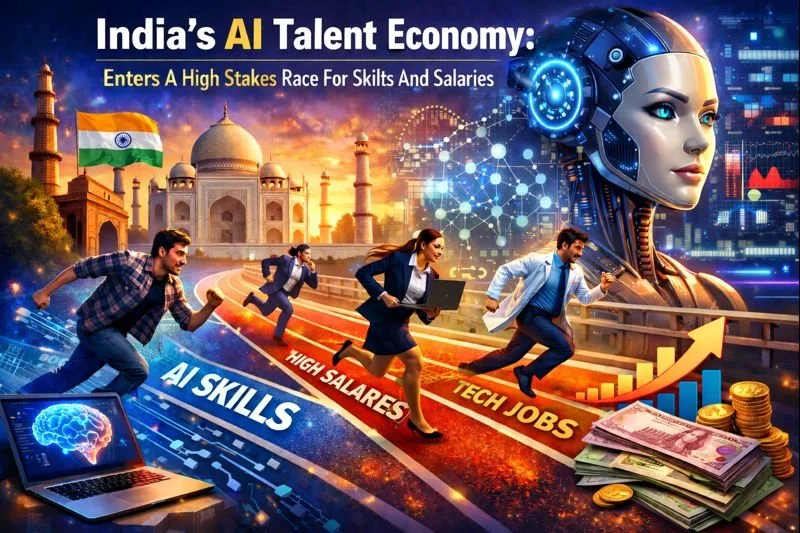
The AI boom is causing an unprecedented battle for top tech talent, with startups offering over $300,000 to new graduates and Big Tech spending billions to secure elite AI scientists, even as automation threatens traditional tech roles.
The tech industry, long celebrated for its innovation and high-flying careers, is currently experiencing a seismic shift, marked by a paradox: while artificial intelligence poses a looming threat to traditional tech jobs, it is simultaneously fueling an unprecedented and intensely competitive talent war for top-tier AI specialists. This fierce competition is driving salaries for newly-minted computer science graduates into territory once reserved for seasoned professionals at tech giants, with some firms offering upwards of $300,000 annually. This comes as venture-backed startups are seeing median base salaries for software engineers jump by 25% since 2022, reaching $200,000, according to data from Levels.fyi, as cited by Yahoo Finance. This explosive demand for AI expertise highlights a critical juncture for the global tech landscape, where the mastery of AI development is becoming the ultimate currency.
For decades, Silicon Valley's allure wasn't just about the promise of innovation; it was also built on an attractive lifestyle package – think cold brew, nap pods, and quirky office perks. However, as the AI arms race intensifies, these fringe benefits are increasingly overshadowed by a far more potent incentive: astronomical compensation packages. Chris Vasquez, CEO of the recruiting firm Quantum, noted a dramatic change, telling The Wall Street Journal referenced in the Yahoo Finance article, that until recently, he'd "probably never seen anyone over $300,000 on base salaries at seed companies." Now, fresh graduates with exceptional AI skills are commanding "FAANG-level cash comp," a testament to the surging demand for specific, high-value capabilities. This shift underscores a fundamental re-evaluation of worth within the tech sector, where specialized AI knowledge is now at a premium, disrupting traditional compensation benchmarks.
The current frenzy for AI talent is unprecedented, driven by the dual forces of rapid technological advancement and a relatively small pool of truly elite experts. AI tools are democratizing company building, making it easier and faster for new ventures to launch and scale, thereby intensifying the competition for those who can architect these new solutions. This short-term boon for young engineers entering the workforce, as noted by Yahoo Finance, stands in stark contrast to the broader, long-term concerns about AI's potential to displace traditional tech roles. The most intense battle for talent is centered on a group of fewer than 1,000 AI research scientists globally who possess the rare ability to build advanced large language models. The stakes became evident when OpenAI CEO Sam Altman disclosed that Meta reportedly offered signing bonuses as high as $100 million to lure top talent. The ChatGPT-maker itself set a new benchmark, with an average stock-based compensation reaching a staggering $1.5 million per employee in 2025, according to the WSJ, making it the highest of any tech startup in history. Beyond base salaries, equity plays a crucial role; employee stock grants at a Series D startup can range from $2 million to $4 million, a figure Tim Tully, a partner at Menlo Ventures, found "unfathomable" just four years ago when hiring research scientists. This escalating arms race for talent is not confined to Silicon Valley's established players but extends globally, reflecting AI's transformative potential across all sectors.
This fervent demand for elite AI talent, juxtaposed against concerns of broader job displacement, is creating a discernible two-tiered economy within the tech sector. On one hand, a small, highly specialized cohort of AI researchers and developers is experiencing unprecedented remuneration and career opportunities. Their skills in foundational AI, theoretical breakthroughs, and large language model development are in such high demand that companies are willing to pay almost any price to secure them. This group represents the vanguard of a new technological era, and their compensation reflects their pivotal role in shaping it. On the other hand, a larger segment of the tech workforce, comprising roles susceptible to automation and AI enhancement, faces increasing uncertainty. While the full impact of AI on job displacement is still unfolding, the emphasis on a specific, high-skill niche suggests a future where adaptability and advanced AI proficiency will be paramount for career longevity. This bifurcation could exacerbate income inequality within the tech sector, creating a highly compensated elite and a more vulnerable, adaptable workforce. This dynamic also shifts the focus for educational institutions and governments, who must now consider how to re-skill and up-skill their populace to meet the demands of this rapidly evolving technological landscape, ensuring that the benefits of AI are broadly shared rather than concentrated among a select few. The investment in AI education and infrastructure, as seen with initiatives like the Google Accelerator in India, becomes not just an economic imperative but a societal one.
The intense focus on AI talent and development is not limited to the traditional tech hubs of Silicon Valley. Emerging ecosystems are also rapidly scaling up their AI capabilities, with significant strategic investments. India, for instance, is experiencing an AI startup boom, highlighting the global reach of this technological revolution. According to ICTworks, artificial intelligence accounted for a staggering 84% of India’s deep tech startups and 91% of deep tech funding in 2025. This surge, however, comes with its own set of challenges, particularly for early-stage companies. Seed-stage funding in India saw a 30% decline last year, indicating increased investor selectivity despite the overall growth. To address this funding gap and foster innovation, Google has launched the "Google for Startups Accelerator: India" program. This equity-free initiative targets Seed to Series A stage startups building core AI applications, offering critical mentorship from Google engineers, access to Cloud credits and TPUs for machine learning research, and strategic support in areas like product design, customer acquisition, and growth strategy. The program, accepting 10-15 startups, underscores the critical need for both capital and expertise to translate AI innovation into sustainable growth, especially in developing new agentic, multimodal, and generative AI solutions.
The current landscape suggests that the demand for top-tier AI talent will only intensify, making it one of the defining challenges and opportunities for the tech industry in the coming years. While entry-level salaries exceeding $300,000 and seven-figure total compensation packages for experienced AI researchers are becoming the norm, this phenomenon also highlights a critical talent gap. The scarcity of individuals capable of working on foundational AI and theoretical breakthroughs means that companies, both established giants and nimble startups, will continue to engage in fierce bidding wars. This trend is likely to drive further innovation in how companies attract, retain, and develop AI talent, potentially leading to more flexible work models, enhanced research environments, and even more aggressive compensation structures. Beyond salaries, the strategic importance of employee equity, which can offer multi-million dollar payouts, will continue to be a significant draw for ambitious professionals. We can expect to see continued investment in AI education and research initiatives globally, as countries and corporations vie to cultivate the next generation of AI innovators. The success of programs like Google's Accelerator in India will be crucial in ensuring a broader global distribution of AI capabilities and preventing an even greater concentration of power and talent in established tech strongholds.

Amidst tech stock declines, AI and robotics ignite massive investment, with OpenAI eyeing an $850B+ valuation and Jeff Bezos backing key innovators.

Young entrepreneurs, some still in high school, are leveraging AI to launch multi-million dollar startups, attracting VC attention and reshaping the tech landscape with unprecedented speed.

One of the country's fastest-growing AI startups, Tractian, is significantly expanding its Atlanta presence by moving its headquarters to Coda at Tech Square, tripling its office footprint.