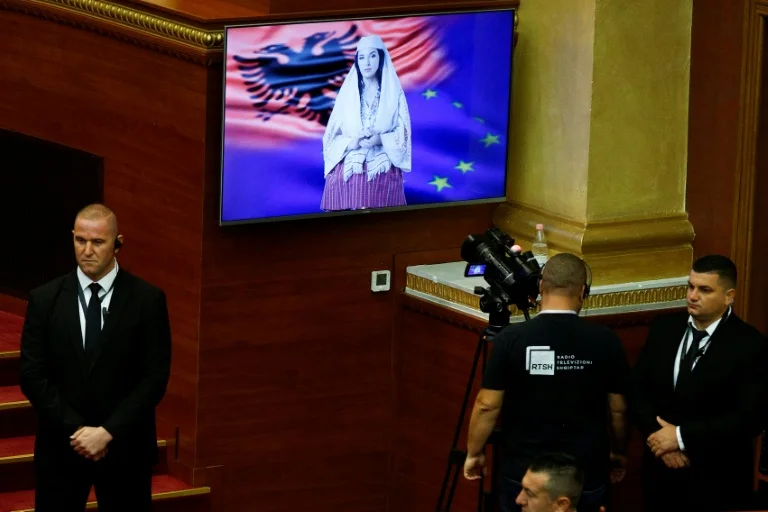
An Albanian actor has filed a lawsuit against her government for using her image and voice to create an "AI minister" without full consent, raising critical questions about digital rights and ethical AI usage.
In a developing story sending ripples through the intersection of technology, governance, and individual rights, an Albanian actor has initiated legal proceedings against her government for the unauthorized use of her likeness to create an "AI minister." Anila Bisha, a seasoned performer, asserts that her face and voice are being exploited for the virtual minister, dubbed 'Diella,' far beyond the scope of her original agreement. This unprecedented legal challenge, highlighted by WKTV, brings into sharp focus the urgent need for clear ethical guidelines and robust legal frameworks governing the rapidly advancing field of artificial intelligence, particularly concerning digital identity and consent. The case underscores a growing global concern about the potential for AI technologies to infringe upon personal autonomy, setting a crucial precedent for how governments and corporations might utilize AI-generated personas in the future.
The concept of digital avatars and AI-generated personas has been steadily gaining traction across various sectors, from customer service chatbots to virtual influencers. However, the deployment of such technologies by governmental bodies, particularly when involving the likeness of a real individual, introduces a new layer of complexity. The Albanian government’s initiative to create an "AI minister" like Diella likely stems from an ambition to modernize public services and improve citizen engagement, perhaps mirroring trends seen in other tech-forward nations. These AI entities are often intended to provide information, answer common queries, or even serve as a public face for digital government initiatives, enhancing accessibility and efficiency. The underlying technology typically involves deepfake capabilities, voice synthesis, and advanced animation to create a convincing, lifelike digital spokesperson. However, as the case of Anila Bisha illustrates, the rapid adoption of these technologies has outpaced the development of comprehensive ethical guidelines and legal protections for the individuals whose identities are being digitized. The lines between a simple digital assistant and a full-fledged AI persona using another person's identity become blurred, leading to potential exploitation and intellectual property disputes, a theme resonating globally as AI becomes more integrated into daily life. While the Hawaii News Now report primarily focuses on local trending topics, the broader context of AI's societal impact is a global phenomenon, with Hawaii, too, likely to face similar legal and ethical challenges.
The core of the dispute revolves around actor Anila Bisha’s claim that her agreement with the Albanian government was far more limited than its current application. According to an Associated Press report via WKTV, Bisha signed a deal that, in her understanding, only covered the e-Albania services platform. This platform is a digital gateway designed to provide citizens with various online government services. However, she alleges that her image and voice are now being used for a broader "AI minister" role, exceeding the agreed-upon terms. Bisha formally filed a request with an administrative court, seeking an injunction to halt the government's continued use of her digital likeness. Her distress is compounded by the fact that, she claims, her repeated attempts to communicate with officials regarding this overreach have been ignored for months. This lack of response further underscores the challenges individuals face when their digital rights are potentially violated by powerful entities. The situation highlights a fundamental disconnect between the initial intent of the contractual agreement and the subsequent, expanded application of her digital identity, raising critical questions about informed consent in the age of advanced AI. Her lawyer has characterized this injunction request as merely the "first legal step," suggesting a potentially prolonged and complex legal battle ahead. At the time of reporting, the Albanian government has refrained from issuing any official comment on the lawsuit, maintaining silence amidst the growing controversy. This evolving story is part of a broader trend of "trending topics" as highlighted across news outlets, from market updates on Investor's Business Daily discussing AI's impact on stock markets to localized entertainment news from Hawaii News Now, all touching on various facets of digital transformation.
The legal challenge brought by Anila Bisha in Albania is more than just a contractual dispute; it's a bellwether case for the future of digital rights, intellectual property, and ethical AI governance. This incident forces a critical re-evaluation of consent in the digital age. When an individual agrees to the use of their likeness in a limited capacity, does the rapid evolution of technology and unforeseen applications nullify or expand that original agreement? This case illuminates the urgent need for comprehensive legal frameworks that address the nuances of digital identity, deepfakes, and AI-generated personas. Current legislation, in many countries, lags significantly behind technological advancements, leaving individuals vulnerable to potentially exploitative uses of their digitized selves. The lack of response from the Albanian government, as reported, also raises concerns about transparency and accountability when state entities deploy advanced AI. If a government can use a citizen's image and voice without clear, ongoing consent and then ignore subsequent objections, it establishes a troubling precedent that could erode public trust and open the door to widespread misuse of AI for propaganda or surveillance. Beyond the immediate legal implications, this case will likely influence how contracts are drafted for digital assets, requiring more explicit definitions of scope, duration, and potential future uses. It also highlights the imperative for international cooperation in establishing global norms for ethical AI development and deployment, ensuring that technological progress does not come at the expense of fundamental human rights and individual autonomy. This situation could serve as a wake-up call for policymakers worldwide that regulating AI is not merely about data privacy but also about personal identity in an increasingly digital world, a topic gaining as much traction as market fears over AI highlighted on Investor's Business Daily.
While the Albanian "AI minister" case is unique in its governmental context, it resonates with broader discussions about intellectual property and celebrity rights in the digital realm. The burgeoning market for deepfake technology, which can convincingly alter or generate images and voices, has already sparked debates in industries such as entertainment and journalism. For instance, the use of deceased actors' likenesses in films, or the unauthorized creation of celebrity "virtual clones," has previously drawn ethical and legal challenges. This current case amplifies those concerns, demonstrating that the issue extends beyond commercial applications to public sector initiatives. Furthermore, the incident serves as a cautionary tale for other governments contemplating similar AI projects. The allure of efficiency and modernity through AI can overshadow the complex ethical and legal considerations involved in representing citizens or delivering public services through synthetic identities. The precedent set by Bisha’s lawsuit could force an accelerated development of "AI ethics boards" or specialized legal bodies within governments to vet such projects before deployment. It also underscores the importance of public engagement and transparent consent processes, rather than simply relying on broad contractual clauses. The broader implications suggest a future where individuals may need to explicitly define the "digital rights" to their own AI-generated identities, much like traditional intellectual property rights. This ongoing saga will likely inform policy decisions, corporate practices, and individual awareness regarding the indelible link between personal identity and the technologies shaping our world, a dynamic as significant as the business reports on the hotel industry or the local sports coverage found on Hawaii News Now.
The outcome of Anila Bisha’s lawsuit against the Albanian government will undoubtedly set a significant legal precedent for the use of human likeness in AI applications, particularly those deployed by state actors. Should the court rule in her favor, it would signal a robust protection for individual digital rights, potentially forcing governments and corporations globally to re-evaluate their approaches to AI persona creation and deployment. This could lead to stricter consent protocols, clearer contractual terms, and potentially, compensation models for the ongoing use of digital identities. Conversely, a ruling against Bisha might embolden entities to pursue more aggressive applications of AI, challenging the very notion of individual ownership over one's digital self. Regardless of the immediate outcome, this case has irrevocably pushed the conversation about AI ethics and governance into the mainstream legal discourse. It will likely spur legislative bodies worldwide to draft more specific laws addressing deepfakes, synthetic media, and the rights associated with one's digital identity. For individuals, it highlights the increasing importance of understanding the terms of service and consent when their voice or image is utilized for any digital purpose. This legal battle is not just about Albania; it's a global flashpoint in defining the boundaries of AI, personal autonomy, and the evolving concept of human rights in a technologically advanced society.

Albanian actor Anila Bisha has taken legal action against her government for using her likeness as an "AI minister" without full consent, sparking debate over AI ethics.

Olympic downhill champion Breezy Johnson accepts an engagement ring in Italy, while an Albanian actor takes legal action against her government for unauthorized use of her image as an 'AI minister.'

Nvidia is developing a Chinese-compatible version of its newly acquired Groq AI chips and resuming H200 processor exports, signaling a critical pivot in its strategy for the lucrative Chinese market amidst US export controls.