

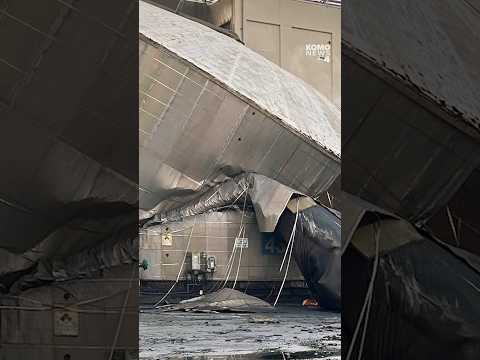
Nippon Dynawave fined over $10 million for deadly Longview tank collapse
Why it matters
The largest workplace safety fine in Washington history and criminal prosecution referral test whether 43 weeks of documented engineering warnings overcome employer immunity defenses in civil and criminal courts.
The big picture
L&I expanded enforcement beyond Longview to inspect every pulp and paper mill in Washington, including Port Townsend Paper Co. across Admiralty Inlet from Kitsap County.
By the numbers
$9,177,127 L&I penalty across 75 violations, $296,500 Ecology fines, $664,776.77 response reimbursement, 43 weeks of unheeded corrosion warnings, 11 workers killed, 12 injured.
Bottom line
Nippon Dynawave has 15 working days to appeal L&I citations and 30 days on Ecology penalties while pulp production remains shuttered ahead of a targeted December restart.
Go deeper
L&I findings for two remaining Longview mill inspections are due December 9 and December 28, statewide mill audit results arrive in February 2027, and the federal CSB final report is slated for spring 2027.
Washington state regulators have levied a record $10,138,127 in combined safety penalties, environmental fines, and emergency response charges against Nippon Dynawave Packaging Co. and referred the company for potential criminal prosecution following a May 26, 2026 chemical tank rupture in Longview that killed 11 workers and injured 12 others. In citations issued November 20, the Washington State Department of Labor & Industries assessed $9,177,127 across 75 workplace safety violations, the largest fine in agency history. The Washington State Department of Ecology added $296,500 in environmental fines alongside $664,776.77 in emergency reimbursement costs, reported by state agencies at roughly $961,000 combined.
Investigators who reviewed more than 40,000 documents and interviewed over 70 witnesses concluded that mill managers operated the corroded G-tank for 43 weeks after receiving outside engineering reports showing its steel walls had thinned below minimum safe limits. Nippon Dynawave disputed the agency's characterization of its conduct as egregious and willful and signaled plans to appeal within Washington's 15-working-day statutory deadline.
How Forty-Three Weeks of Corrosion Warnings Preceded the May 26 G-Tank Failure
The disaster centered on G-tank, a 1.2-million-gallon atmospheric carbon-steel vessel built in 1986 and 1987 without secondary containment to store heated caustic white liquor at roughly 200 degrees Fahrenheit. In kraft papermaking, white liquor combines sodium hydroxide and sodium sulfide at a pH near 13 to dissolve lignin from wood chips inside pressurized digesters. According to the Department of Labor & Industries investigation summary, workers had replaced the tank's second and third steel wall courses in April 2011 and its first and fourth courses in September 2017, a year after Tokyo-based Nippon Paper Industries purchased the Longview complex from Weyerhaeuser.
In July 2025, external ultrasonic testing performed by contractor Applied Technical Services found that lower shell sections had corroded far below engineering thresholds established under American Petroleum Institute Standard 653. According to an August 28 U.S. Chemical Safety Board update, that report explicitly warned management in August 2025 that G-tank was not fit for continued service unless repaired and carried a high likelihood and consequence of failure. Follow-up ultrasonic tests in October 2025 and February 2026 confirmed accelerating metal loss.
Course 2 was built at 0.875 inches thick with a minimum safe standard of 0.508 inches, yet February 2026 testing measured sections at 0.178 inches, and post-rupture measurements along the tear dropped to 0.07 inches, more than seven times thinner than the safety floor. Course 3 had narrowed to 0.270 inches against a 0.341-inch limit. Although plant leaders discussed monthly monitoring in September 2025 and requested 2026 replacement funding from parent executives, L&I found no monthly inspections occurred in November, December, January, March, April, or May after parent leadership told Longview managers in April 2026 to cut capital expenses first.
Morning Timeline of the Collapse and Emergency Response Breakdowns
Mechanical strain reached a breaking point during a routine production upset in the early hours of May 26, 2026. Federal investigators documented that a digester outage around 1:55 a.m. slowed white liquor demand before outflow from G-tank stopped completely at about 4:08 a.m. Because recausticizing equipment continued pumping hot liquor into the vessel, G-tank filled to approximately 90 percent capacity, holding more than 900,000 gallons by 6:22 a.m. State engineers calculated that the resulting hydrostatic head exceeded twice the stress tolerance of the corroded lower rings.
At 7:08.48 a.m., moments after morning maintenance crews gathered inside adjacent ground-floor shops, G-tank ruptured and sent a wall of scalding caustic fluid surging across the mill courtyard. As reported by Oregon Public Broadcasting, the release killed eight employees in the electrical maintenance shop, two in the mechanical maintenance shop, and one operator in the courtyard. Force from the surge crushed parked vehicles, blew out roll-up doors and an exterior wall, and prevented recovery of the final victim for four days due to lingering chemical hazards.
Regulators found that disorganized emergency response compounded the toll. L&I timelines show an internal radio call went out at 7:14 a.m., 911 was dialed at 7:18 a.m., and outside emergency crews reached the main gate at 7:25 a.m., nine minutes before the plant's nominal incident commander reported being on the way. According to L&I, the company never established an effective employer-led command structure, failed to warn neighboring industrial tenants, and omitted the chemical hazard from initial radio dispatches, contributing directly to serious burn injuries suffered by four of the 12 injured workers and responders.
Inside L&I's $9.18 Million Penalty Structure and Ecology's $961,000 Enforcement
The financial penalties announced November 20 separate workplace safety enforcement from environmental cleanup recovery across more than 100 individual regulatory findings. Inside L&I Inspection 317991408, the $9,177,127 total spans 64 egregious willful serious citations, six willful serious citations, and five serious citations. The largest single block, $7,117,102, comprises 43 egregious willful serious violations, one for each week Nippon Dynawave kept G-tank operating after receiving the July 2025 inspection report in August 2025.
Beyond G-tank itself, state inspectors cited 14 egregious willful serious violations totaling $1,048,740 for failing to complete or act upon internal inspections across G-tank and 13 additional site tanks, alongside three egregious willful serious citations totaling $224,730 for skipping required fitness-for-service evaluations on three other vessels. Four more egregious willful serious citations adding $299,640 addressed incident-command breakdowns tied to four response injuries. Six willful serious citations ($449,460) and five serious citations ($37,455) covered inadequate alarms, buddy-system gaps, training deficits, and missing five-year ultrasonic tests or unaddressed inspection findings across G-tank and 28 other tanks on site.
Separately, the Department of Ecology issued a $296,500 notice of penalty across 34 air, water, and dangerous-waste violations, comprising $141,000 for wastewater permit breaches into the Columbia River, $148,000 for hazardous-waste rules, and $7,500 for clean-air violations, while ordering $664,776.77 in reimbursement for Ecology and Washington State Military Department emergency operations. Caustic runoff reached storm drains, bypassed wastewater treatment, and caused widespread fish kills in an adjacent ditch over eight days, leaving Nippon Dynawave open to a separate Natural Resource Damage Assessment. Under state law, L&I fines deposit into Washington's workers' compensation supplemental pension fund for injured workers and surviving families, as noted by Claims Journal.
Why L&I Built Per-Week Citations After the 2010 Tesoro Ruling
At $9,177,127, the Nippon Dynawave citation more than triples Washington's previous workplace safety record, a $2.93 million fine issued after the 2010 Tesoro Anacortes refinery heat-exchanger explosion that killed seven workers. L&I Director Joel Sacks noted that even federal OSHA has issued only three workplace penalties above $9 million nationwide. Yet the legal history of the Tesoro penalty explains the unusual architecture of L&I's Longview enforcement action: in 2017, after years of administrative litigation, a judge vacated the Tesoro fine on grounds that regulators failed to meet their burden of proof, even though families later won a $39 million civil settlement.
As KIRO 7 reported, Washington statutes do not prescribe stand-alone periodic tank-thickness rules for pulp mills. Instead, regulators enforce atmospheric storage tank integrity under Revised Code of Washington 49.17.060(1) and the general "safe place" mandate in Washington Administrative Code 296-800-11005, which requires employers to maintain recognized hazards under the national engineering codes they adopt internally.
By anchoring all 43 weekly egregious-willful counts to American Petroleum Institute Standard 653, which Nippon Dynawave itself referenced in internal mill procedures, and pairing each count with three dated contractor ultrasonic reports and September 2025 management emails, L&I built an evidentiary firewall against the kind of wholesale dismissal that erased the 2010 Tesoro penalty. Even if an administrative judge trims individual counts or questions whether April budget deferrals rose to willful indifference, separating per-week G-tank citations from emergency-response and 13-tank inspection failures makes it far harder for an appeal to zero out the entire assessment.
Criminal Referral and Civil Immunity Collide in Longview Courts
Because state investigators concluded that willful safety violations directly caused 11 deaths, L&I formally referred the case to prosecutors for potential criminal charges, paralleling an active criminal investigation inside the Washington State Attorney General's Office. U.S. Sen. Patty Murray praised the record penalties and criminal referral after disclosures of repeated unheeded warnings, while Association of Western Pulp and Paper Workers spokesperson Josh Estes said union members are demanding direct participation in verifying corrective safety measures.
Nippon Dynawave signaled it will fight the findings on administrative appeal, stating that the egregious and willful label omitted important facts and context and arguing that L&I's citations do not establish technical root cause. Meanwhile, a two-front legal collision is unfolding in civil court. Attorneys for the company moved in October to dismiss a wrongful-death lawsuit brought by Mackenzie Ammons, whose husband Jared was killed on the morning they had scheduled their first prenatal ultrasound, arguing that Washington's Industrial Insurance Act shields employers from civil suits unless management possessed actual knowledge that fatal injury was certain to occur.
That statutory immunity standard sets a high statutory bar for grieving families, including a second lawsuit filed by the estates of workers CJ Doran, 26, and Dillon Miller, 27, which also named neighboring operators Weyerhaeuser and North Pacific Paper Co. along with Japanese parent Nippon Paper Industries. While University of Washington occupational health professor Marissa Baker cautioned that large safety fines are frequently reduced during appeals, L&I's unsealed evidence of 43 weeks of unacted thinning warnings, skipped monthly inspections, and rejected replacement requests tests the outer limits of Washington's workers' compensation immunity shield while raising immediate criminal exposure.
Statewide Mill Inspections Reach Port Townsend and Remaining Open Probes
The enforcement reckoning extends well beyond G-tank and Cowlitz County. According to L&I response records and reporting by Washington State Standard, regulators still have two separate active inspections underway at Nippon Dynawave's Longview facility: one opened June 12 over unrelated workplace hazards with citations due by December 9, and another opened July 1 after a forklift operator handling a sulfuric acid tote was hospitalized, facing a December 28 statutory deadline. Those follow an earlier $77,800 fine issued after a worker fell into a scalding 145-degree pulp sinkhole, a $2,890 ammonia-valve record penalty in August, and more than 30 prior spills or chemical-injury reports documented at the mill since 2019.
State regulators have also widened their inspection dragnet across Washington's entire pulp and paper sector, impacting communities directly adjacent to Puget Sound. L&I opened targeted compliance inspections at Washington's two other kraft mills, Port Townsend Paper Co. across Admiralty Inlet from Kitsap County and neighboring Smurfit Westrock in Longview, alongside inspections at all seven non-kraft mills statewide, with full sector findings scheduled for release in February 2027.
At the Longview plant, which employs roughly 530 workers and serves as Nippon Paper Industries' sole U.S. manufacturing site, Nippon Dynawave has already drained certain vessels and brought in outside engineers under mandatory abatement orders, though pulp production remains shuttered ahead of a company-targeted December restart. Federal investigators at the U.S. Chemical Safety Board expect to publish their complete root-cause findings and national safety recommendations in spring 2027, setting up a decisive six-month test for mill safety oversight across Washington.

Editorial Team
The Vyraa Newsroom is the staff byline of Vyraa, an independent local news outlet covering Bremerton, Kitsap County, and Washington State, published by Nyza Creations LLC. Stories under this byline are researched and written by the Vyraa editorial team from local and regional out…


