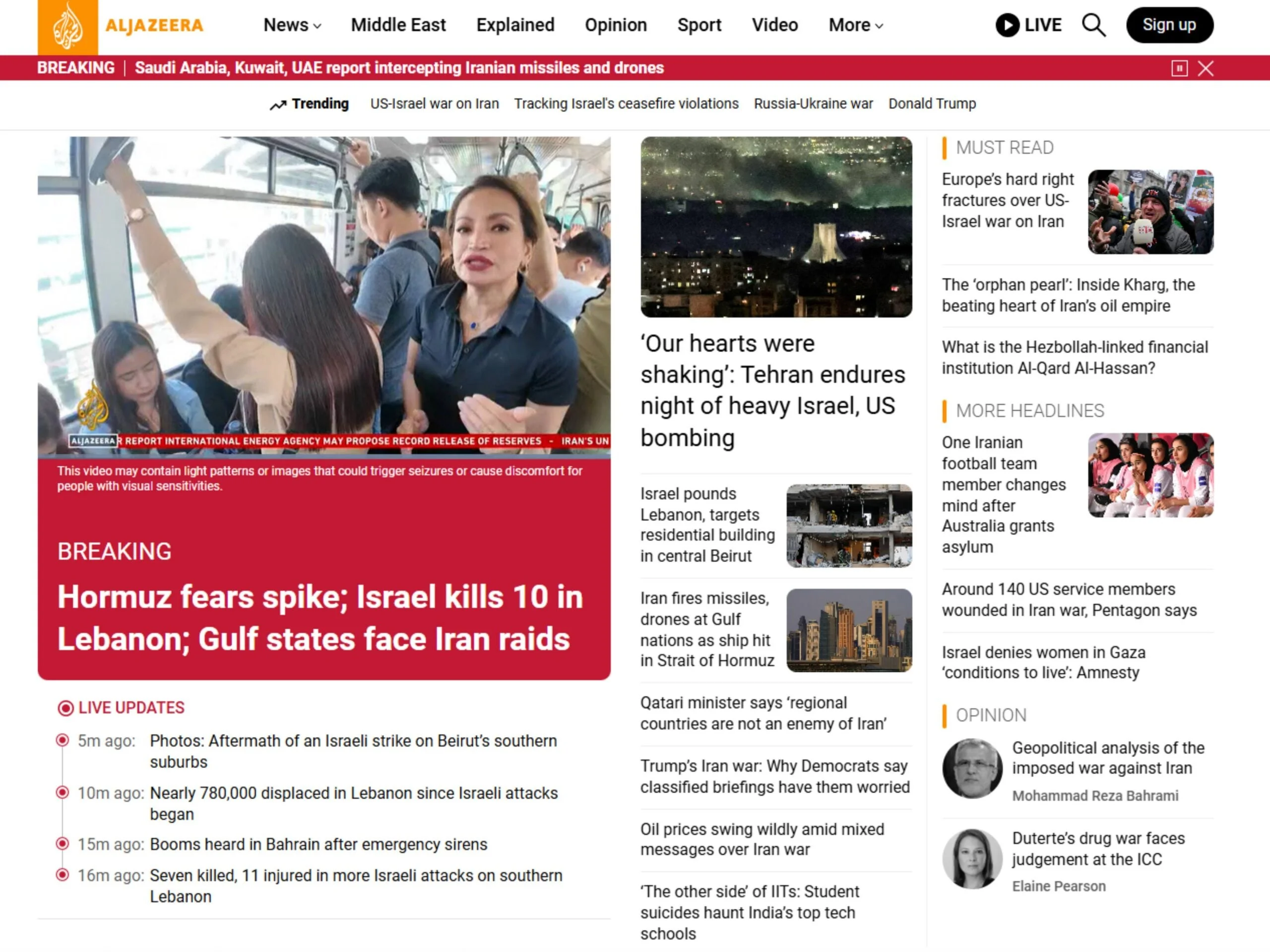
Qatar-based media giant Al Jazeera has emerged as the unequivocal leader in year-on-year traffic growth among the world's top 50 English-language news websites, recording a staggering 62% surge in visits during February. This significant uptick, translating to 63.4 million visits, starkly contrasts a broader trend of decline experienced by the majority of its competitors. The impressive performance is largely attributed to escalating geopolitical tensions in the Middle East, including significant US military actions in the region, which have driven a global search for news and analysis from the epicentre of the conflict. This marks a pivotal shift in the media landscape, ending newsletter platform Substack's seven-month reign at the top of the growth charts, as detailed by Press Gazette.
Background and Context: A Shifting Media Landscape
The digital news ecosystem has been in a constant state of flux for years, grappling with algorithm changes, content fatigue, and a fiercely competitive market. The Press Gazette's monthly rankings, based on Similarweb data, consistently highlight the volatility of online news consumption. For several months leading up to February, the narrative was dominated by the meteoric rise of Substack. The newsletter platform had carved out a niche for independent journalism and expert commentary, maintaining the highest year-on-year growth for seven consecutive months, beginning in July 2025. Its success underscored a growing appetite for direct-to-consumer content and diversified news formats beyond traditional media outlets. However, while Substack continued its impressive trajectory with 37% year-on-year growth in February, reaching 153.3 million visits, global events have demonstrated their capacity to rapidly reshuffle audience priorities and, consequently, traffic patterns. The broader trend has seen a challenging year for many, with 40 out of the 50 tracked sites experiencing year-on-year declines in February, indicative of a wider contraction in online news engagement for many established players.
Key Developments: Geopolitics Reshapes News Consumption
February's data, as analyzed by Press Gazette, underscores how global events can dramatically shift audience attention and news consumption patterns. Al Jazeera's remarkable 62% year-on-year increase in traffic to 63.4 million visits is primarily linked to heightened interest in Middle East news. The US launched strikes targeting Iran on February 28, a significant escalation in an already volatile region. Further reports indicate an intensifying conflict, with headlines such as "Iran US-Israel War Latest News: Iran Warns Oil Could Hit $200 Barrel as Strait of Hormuz Crisis Deepens" and "US-Iran-Israel Conflict: Iranian Drones Strike Oman’s Salalah Oil Tanks on Day 12 of War," highlighting the severe ramifications of these tensions, as seen in The Sunday Guardian. This period of geopolitical unrest has undoubtedly positioned Al Jazeera, with its deep regional coverage and English-language platform, as a crucial source for international audiences seeking real-time updates and analysis.
Close behind Al Jazeera in year-on-year growth was Canadian broadcaster CBC, which saw its traffic jump by 38% to 102.7 million visits. While specific reasons for CBC's surge aren't detailed in the provided data, it represents a strong performance in a generally challenging environment. Substack, despite ceding the top spot in year-on-year growth, still posted a healthy 37% increase, indicating continued strength in its niche. However, its 8% month-on-month decline hints at the broader seasonal fluctuations or perhaps a slight cooling in its previously explosive growth. On the other hand, the vast majority of sites – 40 out of 50 – experienced year-on-year traffic declines. This downturn was particularly pronounced for several India-based news outlets, including India.com (down 71% to 41.7 million visits), Hindustan Times (down 57% to 103.2 million), Indian Express (down 48% to 75.1 million), and News 18 (down 41% to 96.4 million). US site Newsweek also suffered a significant 48% drop, reaching 47.2 million visits. These steep declines reflect a significant global rearrangement of news consumption priorities, impacting regional and general news sites disproportionately compared to those covering immediate high-stakes international events.
Analysis: The Geopolitical News Dividend and Industry Implications
Al Jazeera's dramatic surge in February is more than a momentary spike; it represents a tangible manifestation of what can be termed the 'geopolitical news dividend.' In times of global crisis, audiences instinctively gravitate towards news organizations perceived to offer in-depth, on-the-ground reporting from affected regions. For Al Jazeera, its headquarters in Qatar and extensive network across the Middle East provide a distinct advantage in covering the escalating tensions between Iran, the US, and Israel. This allows them to offer a perspective and level of detailed reporting that general news outlets might struggle to match. The implication for the wider news industry is profound: while hyper-local and niche content platforms like Substack continue to demonstrate their value, major international crises re-emphasize the enduring importance of established news brands with deep regional expertise and established infrastructure for foreign coverage. These events also highlight the global interconnectedness of news consumption; a conflict in one corner of the world can directly influence traffic metrics for news outlets internationally.
Conversely, the widespread year-on-year decline affecting four-fifths of the top 50 sites, particularly the sharp drops experienced by Indian news portals, suggests a broader re-evaluation of news consumption habits. This could be due to several factors: news fatigue, the increasing balkanization of online audiences, or perhaps a saturation point in general news consumption. It also forces a critical look at the sustainability of ad-revenue-driven models for many news sites. When global attention shifts dramatically to specific, high-stakes events, news organizations that are not directly positioned to cover these stories with unique insight may find themselves struggling to maintain engagement. For Indian sites, in particular, this decline could also be indicative of changes within their domestic digital consumption patterns, increased competition, or a general cooling from peak engagement periods. The media industry must continually adapt, not just to technological shifts, but also to the dynamic geopolitical landscape that dictates where audiences direct their attention and, consequently, their clicks.
Additional Details: Monthly Shifts and Methodological Notes
While the year-on-year figures paint a broad picture, the month-on-month data reveals the immediate volatility and responsiveness of news audiences. In February, only eight of the 50 sites tracked by Press Gazette saw an increase in traffic compared to January. CBC led this short list with an impressive 60% month-on-month growth, building on its already strong year-on-year performance. India's NDTV also saw a healthy 13% increase to 171.1 million visits, demonstrating that not all Indian sites are in decline. Al Jazeera continued its strong showing with an 8% month-on-month increase, further solidifying its growing influence. These monthly upticks often correlate with specific news cycles or strategic content releases that resonate with audiences in the short term.
However, several notable names experienced significant month-on-month declines. India.com, already struggling with steep year-on-year losses, recorded the highest month-on-month drop of 21% to 41.7 million visits. The Washington Post also saw a substantial 20% decline to 67.1 million visits, a fall that coincided with the news of the publication cutting a third of its staff, including over 300 journalists, at the start of February. This timing suggests that internal organizational challenges and widespread报道 of layoffs may have negatively impacted audience perception and engagement. Other sites experiencing significant monthly declines included The Independent, Russian state-backed RT, and Fox News, all dropping 17%. These figures underscore the fierce competition and the constant need for news organizations to innovate and adapt to maintain audience share. It's also worth noting the methodological changes implemented by Similarweb for calculating the global audience of the BBC online, aiming for more accurate data by accounting for redirects between bbc.co.uk and bbc.com, indicating a continuous refinement in audience measurement techniques across the industry.
Looking Ahead: Sustaining Growth and Navigating Geopolitical Flux
The trajectory of news consumption in the coming months will largely depend on the sustained intensity of global events, particularly those in the Middle East. Al Jazeera's ability to maintain its elevated traffic will be a key indicator of continued international interest in the region. Should tensions persist or escalate further, Al Jazeera may continue to reap the geopolitical news dividend. Conversely, a de-escalation could see a redistribution of audience attention, allowing other news categories and outlets to regain prominence. For the broader news industry, the challenge remains to find sustainable models amid volatile traffic patterns. The stark declines witnessed by many sites, particularly those in India, will necessitate strategic reassessments of content strategy, audience engagement, and potentially diversification of revenue streams beyond traditional advertising. The success of platforms like Substack, even with minor month-on-month fluctuations, signals a continuing appetite for specialized, high-quality content that can foster direct reader relationships. The ongoing shifts in the digital news landscape suggest that adaptability, regional expertise, and a clear value proposition will be crucial for news organizations aiming to thrive in an increasingly fragmented and event-driven news environment.

Editorial Team
The Vyraa Newsroom is the staff byline of Vyraa, an independent local news outlet covering Bremerton, Kitsap County, and Washington State, published by Nyza Creations LLC. Stories under this byline are researched and written by the Vyraa editorial team from local and regional out…