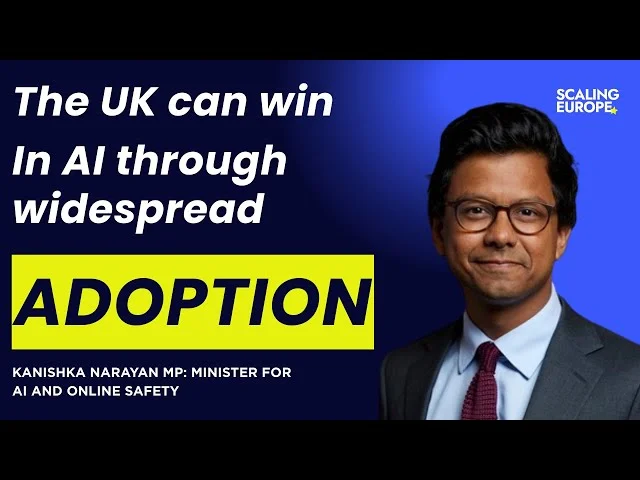
Minister Kanishka Narayan's speech at Founders Forum emphasized UK's commitment to tech ownership, economic stability, and human-centric AI development, drawing parallels to historical design debates.
Kanishka Narayan, the UK's Minister for AI and Online Safety, delivered a compelling address at the Founders Forum on February 10, 2026, challenging British innovators to seize agency in the burgeoning field of Artificial Intelligence. Speaking from the newly established London AI Hub, Narayan invoked a historical parallel with the Great Exhibition of 1851 and the Arts and Crafts movement, framing contemporary AI development within a timeless debate: whether technology serves humanity's aesthetic and practical needs, or if humanity risks becoming subservient to machines. Her speech underscored the government's vision for a UK tech sector characterized by deep British ownership, economic stability, and a commitment to human values, amidst a backdrop of significant growth in venture capital funding for UK startups.
In a thought-provoking opening, Minister Narayan transported her audience back 175 years to the Great Exhibition of 1851, an event that showcased the world's first wave of mass-produced goods in London. Many of these items, as noted by textile designer and social activist William Morris, were "shoddy"—cheap, poorly made, and aesthetically lacking. Morris, a pivotal figure in the Arts and Crafts movement, didn't condemn machines outright but rather advocated for technology to be "the servant of the craftsman." His movement, exemplified by the Kelmscott Press, sought to reconcile industrial advancements with human agency and a commitment to beauty, using technology to create masterpieces rather than dilute quality. Narayan argued that this historical "fork of 1851" presents a central question recurring today: "Does the machine exist to serve what is beautiful about the world, or to replace it with dull mimicry detached from our humanity?" This deep dive into design history, as detailed in the Wired-Gov report, set the philosophical stage for her remarks on modern AI, questioning whether technologies like Grok, often perceived as stripping human dignity, align with or deviate from human-centric progress.
Narayan’s primary message centered on the government's resolve to "wield agency over technology to serve the power of our labour… the need of our economy… the joy of our aesthetic… and the depth of our British values." She candidly acknowledged that "before we can steer the wheel, we need to get to the front of the bus," emphasizing the necessity for greater British technology ownership to secure deeper British influence. The Minister critically assessed the past decade and a half, noting Britain's missed opportunities in the global tech boom and lamenting that no UK startup had reached the FTSE top ten in that period, contrasting sharply with the US where 8 out of 10 had. She attributed this partly to previous governments creating "burdened Britons" rather than "buccaneering Britons."
However, Narayan highlighted significant strides made since, including changes to Enterprise Management Incentives, which now position Britain as a leader for tech startup employees seeking curiosity-driven careers. Pension reforms and increased British Business Bank (BBB) scale-up capital deployments are intended to provide the necessary financial rocket fuel for innovation. Furthermore, a renewed focus on curiosity-driven research with funding for commercialization aims to rekindle the UK's heritage of "moonshot invention." The Minister also pointed to key appointments like Tom Blomfield as AI Ambassador and Katie Gallagher as AI Sector Champion, reinforcing the government's commitment to fostering a vibrant tech ecosystem. Above all, she stressed, the current administration has brought "fiscal credibility and financial responsibility back at the heart of government," a commitment rooted in Keir Starmer's vision for restoring stability, which is crucial for encouraging investment and growth, as reported by Wired-Gov.
Narayan painted a positive picture of the UK's current tech landscape, indicating a robust recovery and significant growth in investment. She asserted that 2025 marked the year financial credibility returned, allowing the UK startup economy to "roar back to life." This resurgence has translated into tangible results: "Investment is flowing again. Founders are building with confidence. The pipeline from idea to scale is wide open once more." Last year alone, UK startups and scale-ups collectively raised approximately $24 billion in venture capital, marking a nearly 35% increase from the previous year and representing one of the strongest performances on record. A substantial portion of this, almost $8 billion, was channeled into UK AI startups, constituting roughly one-third of all venture capital invested into British tech. These figures confirm the UK's position as "Europe’s startup engine," outperforming France and Germany combined in the creation of unicorns, according to the Minister's speech cited by Wired-Gov. This financial buoyancy provides a strong foundation for the human-centric AI development the Minister advocates.
Minister Narayan's speech transcends mere economic boosterism; it represents a deliberate attempt to infuse ethical considerations and a long-term vision into the UK's burgeoning AI sector. By drawing a direct line from William Morris's industrial age critique to modern AI development, she frames the current technological revolution not just as an economic opportunity but as a profound societal challenge. This historical lens encourages British startups to consider the "soul" of their creations, moving beyond simply mimicking human capabilities to truly enhancing human life and agency. This approach is particularly salient given the rapid advancements and ethical debates surrounding AI, from concerns about job displacement to the potential for AI biases and the erosion of human dignity—themes Narayan explicitly touched upon with her reference to "Grok stripping human dignity."
The emphasis on "British ownership" and "influence" is not merely nationalistic; it reflects a strategic imperative to ensure that the values and needs of the UK populace guide the development and application of powerful AI technologies. Without domestic ownership and influence, the risk remains that AI development will be driven by external priorities that may not align with British societal values. Moreover, the government's focus on fiscal credibility and stability, as a prerequisite for fostering innovation, highlights a pragmatic recognition that even the most innovative ideas require a stable economic environment to thrive. This dual focus on ethical innovation and robust economic policy suggests a more mature and deliberate strategy for AI development, attempting to learn from past economic missteps while proactively addressing future ethical dilemmas. The Minister's speech, therefore, signifies a pivotal moment where the UK is not just chasing technological advancement but is also attempting to define its philosophical compass within the global AI race.
The "London AI Hub," which hosted the Founders Forum event, stands as a tangible representation of the UK’s commitment to fostering a collaborative and innovative AI ecosystem. Its rapid establishment within a year, as highlighted by Narayan, signifies the momentum and dedication behind the initiative to create a physical heart for Britain's AI community. The structural reforms mentioned in her speech, such as improved Enterprise Management Incentives (EMI), are crucial details for founders and employees alike. EMI schemes offer significant tax advantages for employees receiving share options, making them a powerful tool for attracting and retaining talent in startups—a critical factor for growth-stage companies vying for skilled professionals. Paired with pension reforms and increased capital deployment via the British Business Bank (BBB), these measures are designed to unlock domestic capital and redirect it towards high-growth potential businesses, nurturing a new generation of "buccaneering Britons."
The appointment of figures like Tom Blomfield (Monzo co-founder) as AI Ambassador for British startups and scale-ups, and Katie Gallagher as AI Sector Champion for Digital and Tech, provides a direct line between the government's aspirations and the practical realities of the tech industry. These individuals bring invaluable industry experience and credibility, acting as bridges between policymakers and innovators. Their roles are vital in shaping policies that are responsive to the needs of the tech sector and in promoting the UK as an attractive destination for AI talent and investment. The Minister’s strong assertion that the "UK is once again Europe’s startup engine" with a significant increase in venture capital and unicorn creation underscores a narrative of resurgence, aiming to instil confidence and counteract any lingering perceptions of the UK as lagging in technological leadership, a narrative bolstered by the concrete figures and policy changes outlined in the Wired-Gov coverage.
The path forward for the UK's AI sector, as outlined by Minister Narayan, will involve a sustained effort to build on the current momentum. The challenge lies not just in attracting further investment and producing more unicorns, but in ensuring that this growth is channeled towards socially beneficial and ethically sound innovation. Maintaining a balance between rapid technological advancement and adherence to "British values" and human agency will be critical. The effectiveness of the new policies, from tax incentives to research funding, will be closely watched for their long-term impact on the pipeline from idea to commercialization. Furthermore, the role of the AI Ambassador and Sector Champion will be crucial in translating policy into practical support for startups and scale-ups.
The UK government's ambition to position itself as a leader in ethical AI will require concrete actions and frameworks that go beyond rhetorical commitments. Defining what "human dignity" means in the age of AI and establishing clear guidelines for its protection will be paramount. As AI models continue to evolve at an unprecedented pace, the question of whether British startups can truly "build with agency, to real needs that persist" will define the UK's unique contribution to the global AI landscape. The coming years will reveal if the UK can indeed lead by example, proving that technological prowess and ethical leadership are not mutually exclusive but are, in fact, mutually reinforcing.
Google and Accel's Atoms accelerator rejected 70% of AI startups as 'wrappers,' highlighting a venture capital pivot towards deep tech and proprietary models over superficial integrations.
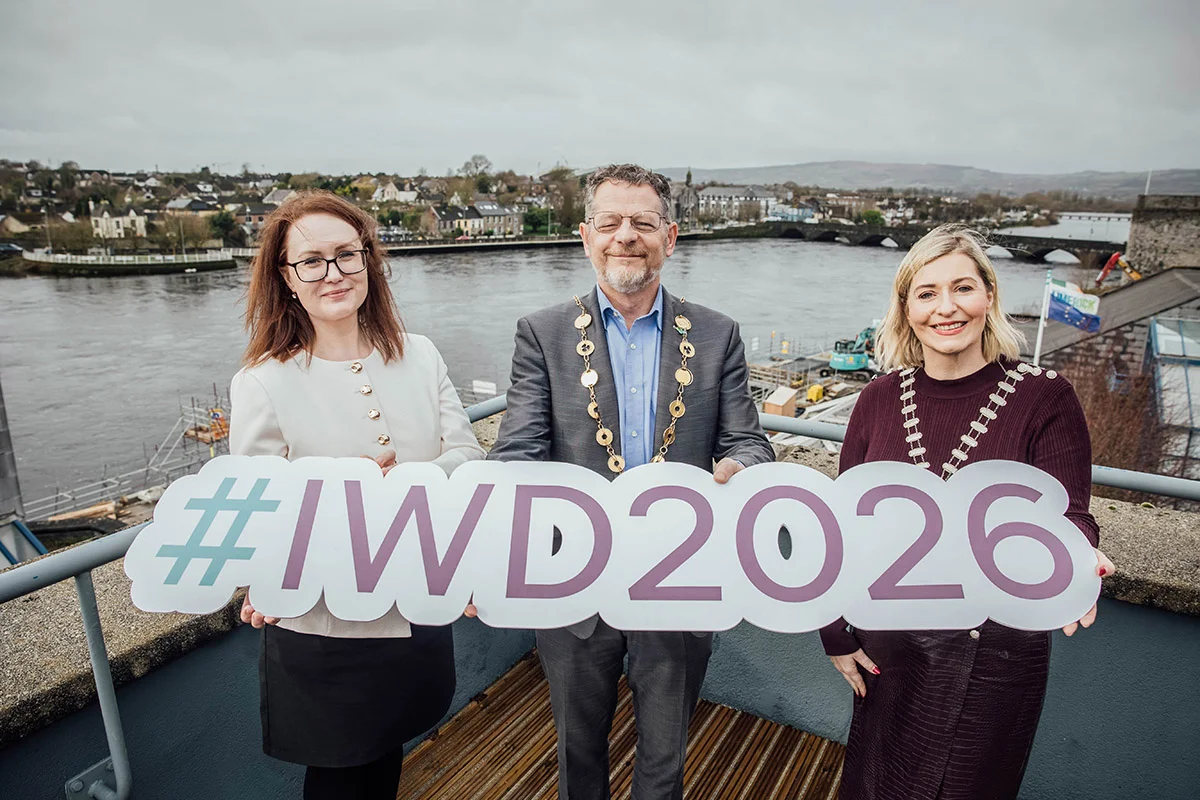
The WeBuild programme reopens for women founders across Ireland, leveraging AI and no-code tools to dramatically cut startup build times and lower technical barriers, fostering a new wave of innovation.
Trellis Group opens applications for its 2026 Climate Tech Startups to Watch list, highlighting a maturing market and increased investor focus on proven technologies across data centers, material innovation, and climate adaptation, as global funding climbs to $40.5 billion.