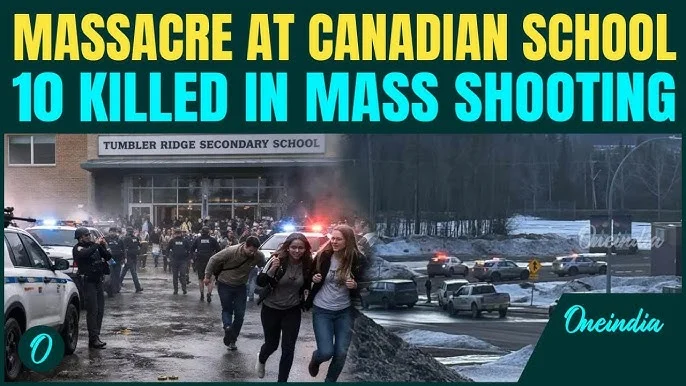
A Nation Mourns: Ten Dead in Rare Canadian High School Massacre in Tumbler Ridge
Ten people, including the shooter, are dead after a mass shooting at a high school in Tumbler Ridge, British Columbia, shaking Canada with an event rare in its history.

Tumbler Ridge, British Columbia – A small, tight-knit community in the foothills of the Rocky Mountains has been irrevocably shattered by an act of horrific violence, as ten people, including the suspected shooter, are confirmed dead following a mass casualty event that unfolded at Tumbler Ridge Secondary School and a connected residence on Tuesday. The tragedy, which saw a female assailant open fire in a Canadian high school, has sent shockwaves across the nation, forcing a reckoning with gun violence typically associated with its southern neighbor. The Royal Canadian Mounted Police (RCMP) reported six fatalities within the school, two at a nearby residence, and one victim who succumbed to their injuries en route to the hospital. At least two others remain hospitalized with serious wounds, while dozens more received medical attention for non-life-threatening injuries, leaving a community grappling with unimaginable loss and the profound question of how such an event could occur in their peaceful town.
Background and Context
The remote municipality of Tumbler Ridge, with a population of approximately 2,400, is known more for its stunning natural beauty and outdoor pursuits than for scenes of urban violence. Located deep in northern British Columbia, roughly 1,155 kilometers northeast of Vancouver, it exemplifies the kind of serene, close-knit Canadian community where such a tragedy was, until now, unthinkable. Tumbler Ridge Secondary School caters to students in grades seven through twelve, with a total enrollment of approximately 160. The demographic profile and isolated nature of the town undoubtedly amplify the shock and grief felt by residents, many of whom likely knew the victims or their families directly. This incident starkly contrasts with Canada's general reputation for stringent gun control compared to the United States, yet it tragically adds to a sorrowful list of mass casualty events that have occasionally pierced the nation's relative calm. Past Canadian tragedies, such as the 1989 École Polytechnique massacre and the 2020 Nova Scotia rampage, serve as grim reminders that no country is entirely immune to such horrific acts, reinforcing the urgency of ongoing discussions around public safety and mental health.
Key Developments
The rapid unfolding of events in Tumbler Ridge began when police received the initial call, prompting a swift response from the town's small police force. According to British Columbia's Public Safety Minister Nina Krieger, RCMP officers were on scene within two minutes of the alert, a response time credited with potentially saving lives. The active shooter alert issued to the public described the suspect as "female in a dress with brown hair," a detail later confirmed by Superintendent Ken Floyd to be the individual found dead at the scene from what appeared to be a self-inflicted injury. All told, ten individuals, including the shooter, lost their lives, marking it as one of Canada's deadliest mass casualty events in recent memory, as reported by Reuters. The discovery of victims at both the school and a connected residence suggests a targeted, multi-location attack, though police have yet to release details on motives or specific connections between the locations. Parents, agonizing over the fate of their children, gathered at a local community center, a scene local pastor George Rowe described as "devastating." The school will remain closed for the remainder of the week, with counseling services made available to students, staff, and the wider community as they grapple with the trauma. Canadian Prime Minister Mark Carney postponed a planned announcement and international trip, expressing his devastation and offering condolences on X (formerly Twitter), highlighting the national significance of this tragedy.
Analysis: What This Means
The Tumbler Ridge shooting serves as a chilling testament to the universal vulnerability to gun violence, regardless of national context or existing gun control measures. While Canada indeed boasts stricter gun laws than the United States – a point emphasized by the Reuters report noting recent restrictions on handguns and assault-style weapons by the Trudeau government – this incident underscores that such laws, while crucial deterrents, are not infallible. The fact that the shooter was identified as female stands out as a stark anomaly in the grim statistics of mass shootings in North America, which are overwhelmingly perpetrated by men. This unusual demographic profile might prompt new psychological and sociological inquiries into the evolving nature of such violence. Furthermore, the tragedy in a remote, "tight-knit community" challenges the often-held perception that such extreme acts are confined to larger urban centers. It forces smaller towns to confront their own preparedness and resilience in the face of scenarios previously considered distant. For parents across Canada, this event reignites anxieties about school safety and the insidious encroachment of a violence that many believed could not take root in their children's protective environments. The immediate and comprehensive support systems being mobilized in Tumbler Ridge will be critical not just for healing the community, but also for providing a template for other small communities should the unthinkable happen again.
Additional Details
The aftermath of the shooting saw significant distress and uncertainty. Student Darian Quist, 17, recounted how his class was locked down for over two hours, starting around 1:30 PM local time. Although he heard nothing directly, the horrific reality of the event became clear as fellow students later shared photos depicting scenes stained with blood. This detail, reported by Reuters, highlights the immediate visual trauma experienced by those inside the school. The process of identifying the victims has been painstaking, with police vowing to release names only after "absolute, unequivocal identification" – a measure designed to provide certainty amidst the widespread grief and confusion. Police have stated they do not believe there are any other suspects or an ongoing threat, allowing the community to begin the long process of mourning without the immediate fear of further danger. Premier David Eby of British Columbia articulated the profound disbelief gripping the region, stating, "It's the kind of thing that feels like it happens in other places and not close to home." The tragic death toll places this event among the most severe in Canadian history, drawing comparisons to the 2020 Nova Scotia rampage and the 1989 École Polytechnique shooting in Montreal, both of which prompted significant national reflection on violence and public safety. These historical events underscore that while rare, such profound tragedies are not entirely unprecedented in Canada, and each instance reignites crucial debates on prevention and response.
Looking Ahead
As Tumbler Ridge begins to heal, the focus will inevitably shift to ongoing investigations into the shooter's motive and how the attack was planned and executed. While there are no further immediate threats, the long-term psychological impact on students, staff, and residents will be immense, requiring sustained counseling and community support. The national conversation around gun control, already a sensitive topic in Canada, is likely to intensify once more, potentially reigniting debates around specific types of firearms that were previously shelved due to opposition from rural communities and hunters. The response of Canadian politicians, including Prime Minister Carney, signals a national recognition of the gravity of this incident, and further policy considerations or funding for mental health initiatives could emerge. For the international community, this tragedy serves as another stark reminder of the global challenges posed by gun violence, cutting across geographical and political boundaries. While global news outlets like Times Now and sports media like Sky Sports are currently focused on other major events, the ripple effects of this Canadian tragedy will undoubtedly lead to broader discussions on safety and security in schools worldwide. The lessons learned from Tumbler Ridge will be crucial in informing future preventative measures and emergency responses, ensuring that the memory of those lost serves as a catalyst for meaningful, lasting change.
Related Articles
Mass Shooting Rocks British Columbia, Cuba Faces 'Breaking Point' Amid US Pressure, US-Iran Tensions Rise
A deadly school shooting in British Columbia leaves ten dead, Cuba faces severe fuel shortages due to US sanctions, and President Trump prepares to meet with Israeli PM Netanyahu amid rising US-Iran tensions.